
In 1854, a young empress fell in love with a fishing village. Napoleon III built his villa there, Europe’s high society followed, and Biarritz became a fashionable resort. A hundred and seventy years on, a few jewels of that imperial dream can still be linked together on foot. Follow the guide.
It all begins with love at first sight. In the summer of 1854, Eugénie de Montijo, newly married to Napoleon III, rediscovers in Biarritz the landscapes of her Spanish childhood. She persuades the emperor to build a summer residence there — the Villa Eugénie, today the Hôtel du Palais — and in her wake, all of crowned Europe arrives. Of that seaside Second Empire, the town has kept traces you can link together in a fine walk.
The Imperial Chapel, the hidden jewel
A stone’s throw from the hotel, on Avenue de la Marne, hides the most moving of the remains. Built from 1864 to 1866 by Émile Boeswillwald, a pupil of Viollet-le-Duc, the Imperial Chapel blends Romano-Byzantine style with Hispano-Moorish decoration. Eugénie dedicated it to Our Lady of Guadalupe, patron saint of Mexico — an echo of the military expedition France was then waging there. The empress inaugurated it on 16 September 1865. Listed as a Historic Monument in 1981, it is today the only surviving building of the imperial residence: a secret many locals have never stepped inside.
The Rocher de la Vierge, Napoleon III’s dream of a harbour
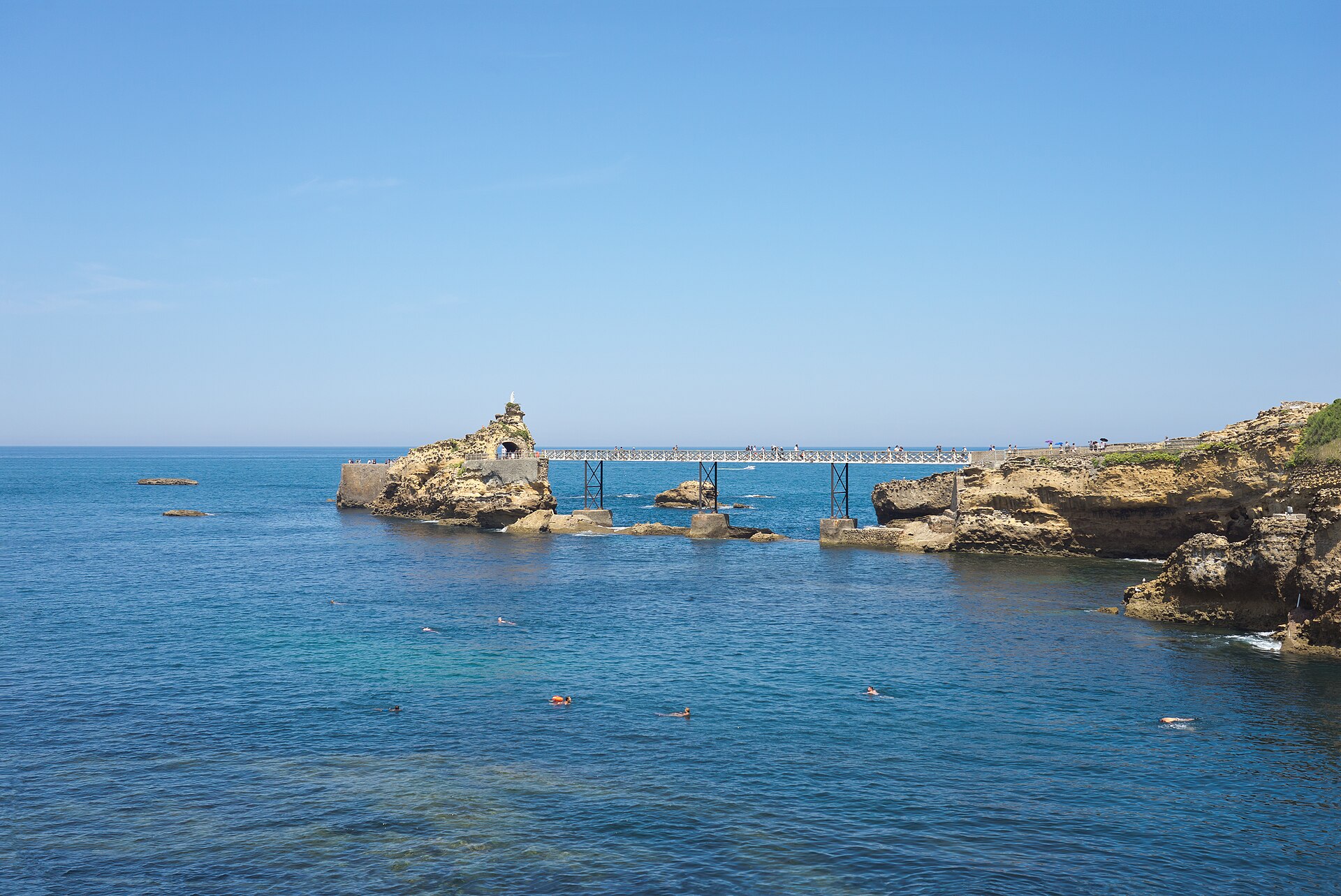
The most spectacular legacy is photographed by everyone, though few know its origin. It was Napoleon III who, dreaming of a great harbour of refuge, had the Atalaye rock pierced and tunnels dug to carry the blocks for the breakwater. The port never came to be, but the gesture left Biarritz its finest balcony over the ocean. In 1865, a bronze Virgin was hoisted there; the metal footbridge leading to it dates from 1886-1887 — often wrongly attributed to Eiffel. In heavy weather, the waves burst against it in sprays: the spectacle is unchanged.
Napoleon III dreamed of a harbour; he left us the finest balcony over the ocean.
The church of Sainte-Eugénie, above the Old Port
The empress’s name marked the town down to its street signs. A first chapel dedicated to Saint Eugénie, patron saint of the sovereign, was inaugurated as early as 1856, its bell tower funded by a gift from Napoleon III. The neo-Gothic church we see today, in grey stone, overlooks the Port des Pêcheurs (the fishermen’s harbour): built from 1898 to 1903, it holds stained-glass windows by Luc-Olivier Merson. The building is currently under restoration — for now, admire it from the outside.
From villa to casino: fashionable Biarritz
What the imperial court really bequeathed was a calling. In just a few summers, Biarritz went from fishing village to a resort favoured by the European aristocracy — Victor Hugo, Queen Victoria, later Edward VII. The Grande Plage, the taste for sea bathing, the villas and palaces of the Belle Époque to come: all flow from that 1854 love affair.
The ici Biarritz shop selection
All about imperial Biarritz — to extend the walk.
- Eugénie, la dernière impératrice (Jean des Cars) — the definitive biography, in which Biarritz plays a fine part. See on Amazon →
- Biarritz, from Villa Eugénie to the Hôtel du Palais — the story of the place, richly illustrated. See selection →
- Napoleon III — a biography to (re)discover the Second Empire. See selection →
- Coffee-table book: Biarritz Belle Époque — the fashionable resort in pictures. See selection →
As an Amazon Associate, ici Biarritz earns from qualifying purchases. This doesn’t change the price you pay.