
This article is part of a series of encounters with local professionals, aimed at better understanding contemporary practices and the expectations they generate.
There is a question many Biarrots ask themselves without always daring to voice it. That quiet desire to take care of oneself, to correct what is tiring, to recover something — without it showing too much, without it altering who one is.
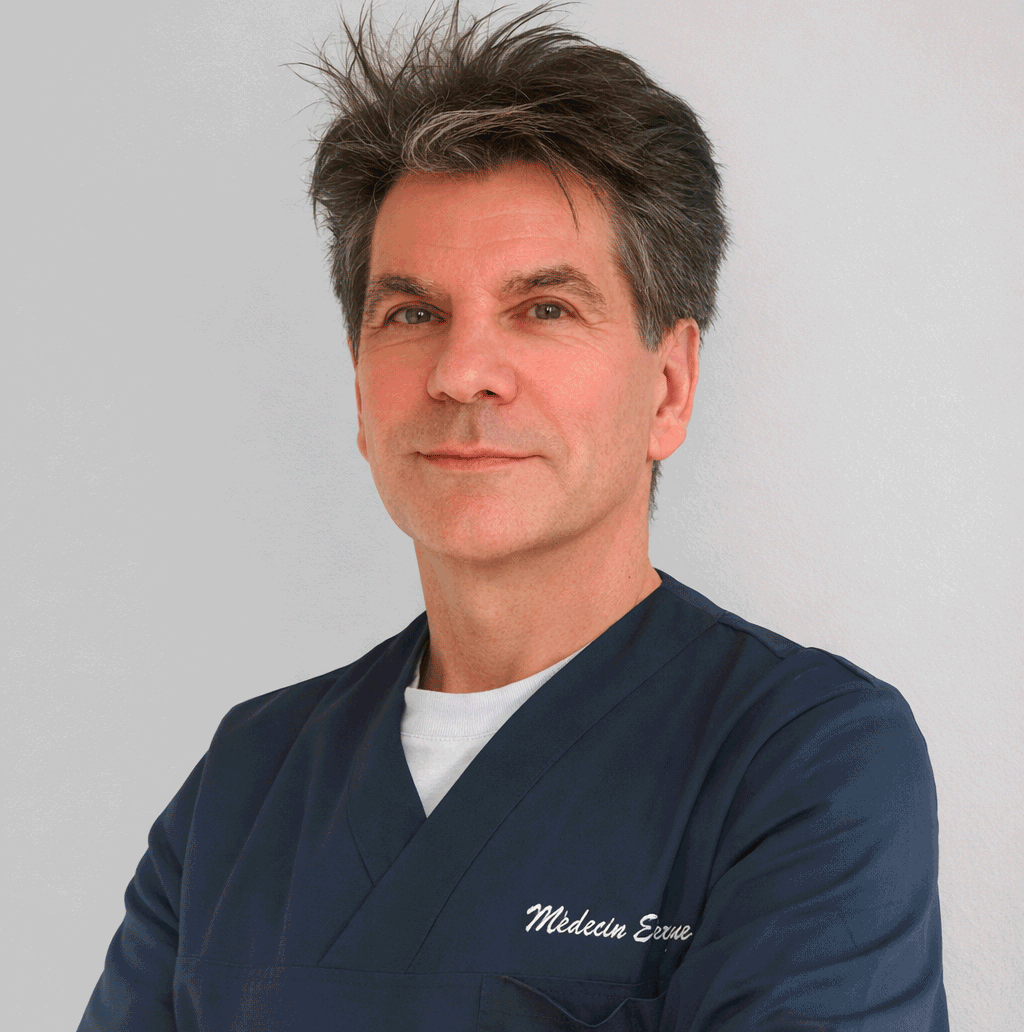
Doctor Éric Peyre has been seeing patients in Biarritz, avenue Édouard VII, for many years. What his patients often mention, even before talking about medicine, perhaps comes down to this: the possibility of asking questions, simply.
We met him for a two-way conversation — a cross-interview, where each party questions the other.
When you think of aesthetic medicine, what is your first image?
It is the question I ask systematically in consultation. Because this first image says a great deal. It often expresses expectations as much as apprehensions. In the answer, there is already part of the conversation that will follow. Aesthetic medicine sometimes suffers from a representation that does not always correspond to the reality of current practices — that of excesses or visible transformations. That is not the approach I take.
What has brought you to consult today, rather than five years ago?
That is also an important question. Not to put anyone on the spot, but to understand a context. An aesthetic request often arises at a particular moment — a change, a realisation, an image that catches one’s attention. That moment deserves to be heard before any proposal is made.
You have been practising aesthetic medicine in Biarritz for many years. What drew you towards this specialty?
General medicine taught me to listen. I then wanted to explore a less-addressed dimension: the relationship each person has with their appearance and what this can convey in terms of experience. I undertook university training, including an Interuniversity Diploma in sexology at Bordeaux II, then in morphological and anti-ageing medicine at Paris XIII University — Sorbonne Paris-Nord. These approaches are part of a broader reflection on the relationship with the body.
One often hears about “natural results”. What does that mean concretely?
It means that the intervention should not be perceptible as such. The aim is to bring improvement without visible transformation. It is more about balance than modification.
How does a first consultation unfold?
It is based first and foremost on an exchange. I observe, I listen, I ask questions about expectations, feelings, any previous experiences. I then explain what medicine can offer within a precise framework, with its indications, limits and constraints. In some cases, this exchange is enough to clarify the decision, without necessarily initiating a procedure.
What training has shaped your practice?
The DIU in morphological and anti-ageing medicine forms an important foundation. It provides a global approach to ageing and physiology. I also take part in continuing education, particularly in the field of medical technologies. I am a member of the French Association of Aesthetic and Anti-Ageing Medicine (AFME), which requires regular updating of knowledge.
Does Biarritz represent a particular context?
The patient base is varied, with very different profiles and expectations. There is nonetheless a frequent search for discretion. This corresponds to a measured approach to these practices.
What do you refuse to do?
Requests that seem inappropriate or disproportionate to me. When there is a gap between an expectation and what can reasonably be proposed, it is important to say so. Aesthetic medicine remains a medical practice, with a responsibility for indication.
Have you ever had the feeling that this approach might be perceived as superficial?
This perception exists sometimes. It refers to an implicit hierarchy between forms of care. Yet the relationship with one’s own image can have a real impact on wellbeing. In some cases, appropriate care can contribute to greater wellbeing, provided it falls within a measured and suitable framework.
Aesthetic medicine remains a regulated field, requiring appropriate indication, clear information and a cautious approach. Like all medical practice, it operates within a defined and evolving framework.
Practical information
Doctor Éric Peyre — Aesthetic Medicine and Morphological Anti-Ageing Medicine
Biarritz practice — 21 Ter avenue Édouard VII, 64200 Biarritz
Appointments Monday to Friday
Registered with the Order of Physicians
Member of the French Association of Aesthetic and Anti-Ageing Medicine (AFME)