
Art · Exhibition · Seoul
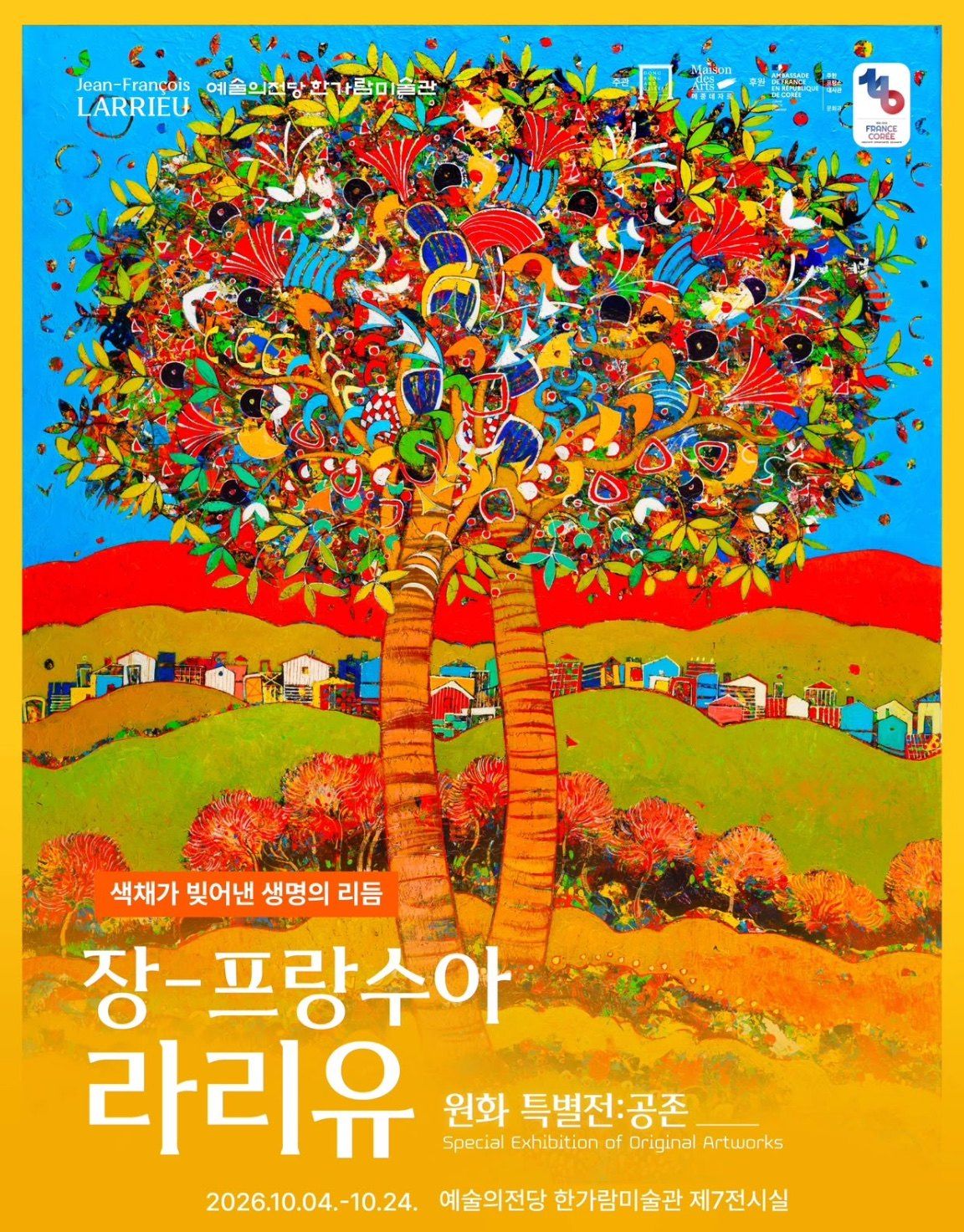
Twenty-four years after his work was first shown to Korean audiences, Jean-François Larrieu has been given what no museum in the country had offered him before: a solo exhibition. “Coexistence” brings together close to eighty original works at the Hangaram Art Museum in the Seoul Arts Center, from 4 to 24 October 2026, ahead of a national tour spread over two years.
A first, not simply another show
The relationship between Jean-François Larrieu and Korea is not new. It begins in 2002, when his work is shown in Seoul and Gwangju as part of a group exhibition devoted to French figurative painting. He returns regularly after that, with solo shows in 2008, 2012 and 2016 — but always in galleries.
Which is what makes this autumn different. “Coexistence” is his first solo exhibition held in a Korean museum, and the largest ever devoted to him in the country: close to 80 original works, including several large formats and media art pieces, gathered at the Hangaram Art Museum in the Seoul Arts Center, the capital’s principal cultural institution.
The exhibition is organised by Dongsung Gallery with Maison des Arts, and is supported by the cultural service of the French Embassy in Korea. It falls within the celebrations of the 140th anniversary of diplomatic relations between France and Korea — the kind of calendar that opens museum doors.
“Coexistence”: the title is the instruction manual
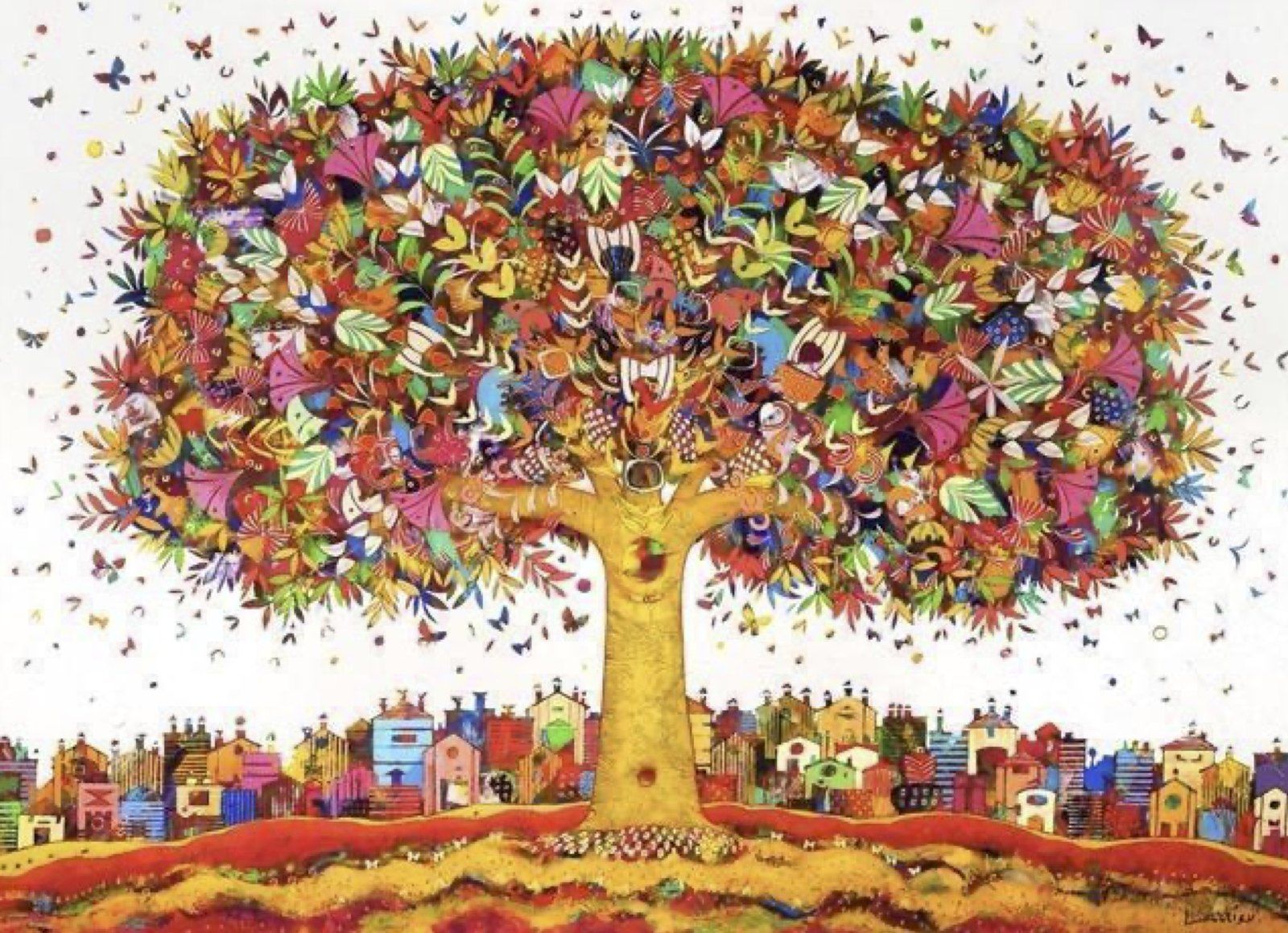
From a distance, a Larrieu is a monumental landscape: a tree, an ocean, a city, an architecture. Up close, the whole thing breaks apart into thousands of triangles, circles, squares and tiny signs, slotted into one another.
And above all: nothing dominates anything. A leaf occupies the same visual and symbolic space as an entire forest; a butterfly weighs as much as a metropolis. That constant dialogue between the infinitely small and the infinitely large carries a simple, stubborn idea — every being, every form takes part in the same balance. Man is no longer at the centre of the painting; he is one element among others.
You can find the argument naive. You can also note that few painters hold an idea this elementary across forty years of work without ever letting go of it.
Five rooms to enter the work
The hang organises that journey into five sections.
“I’m Larrieu” opens the way: a biographical introduction, from childhood to the present, laying out the foundations of his visual language.
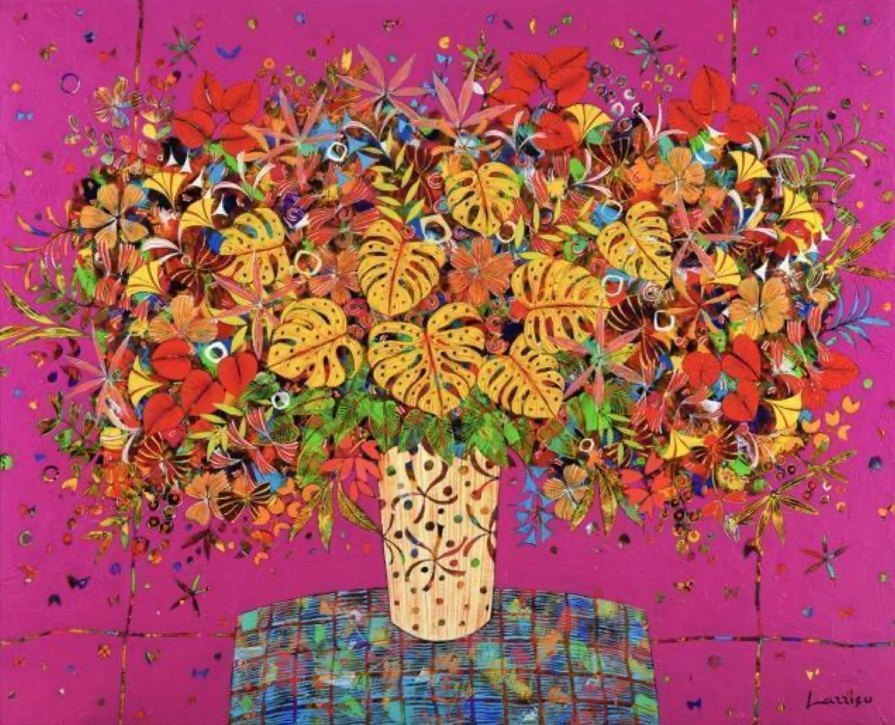
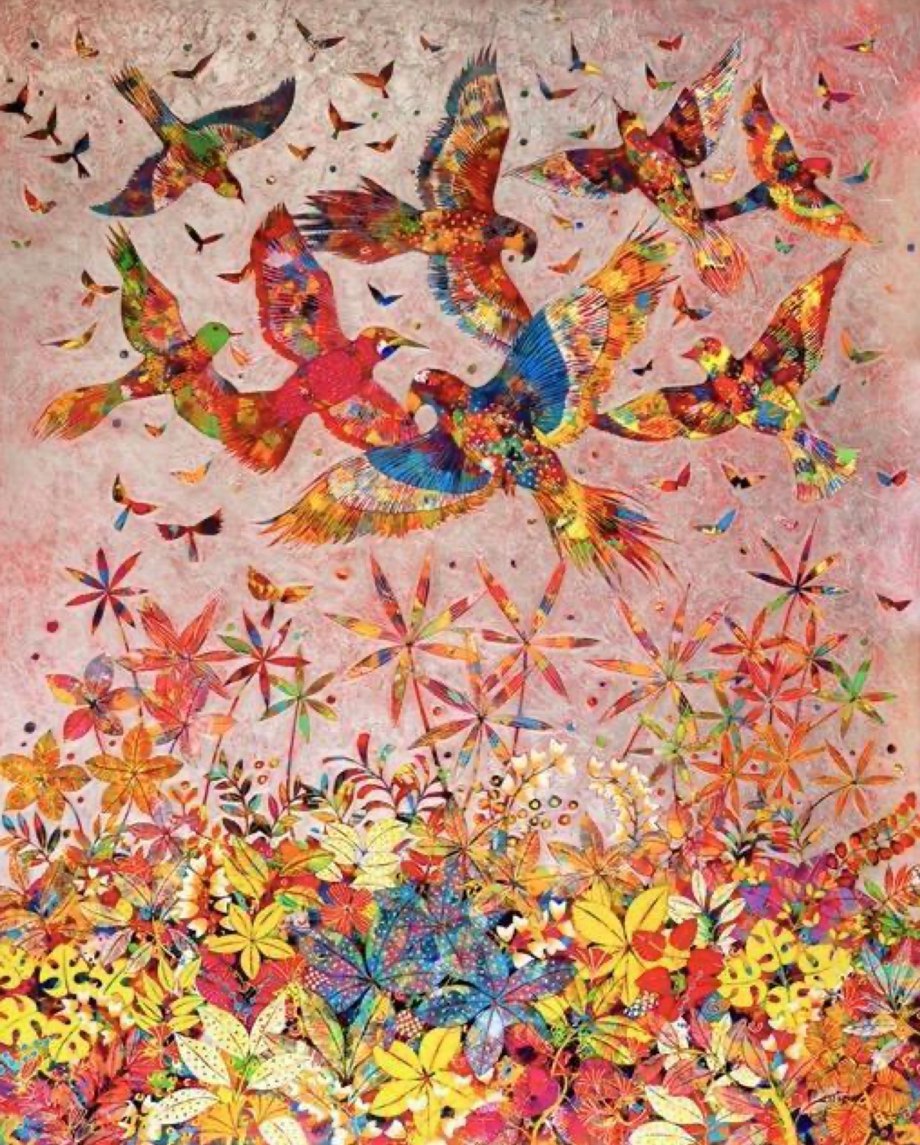
“The butterfly of hope, the bird of freedom” digs into the two recurring figures of his universe — the butterfly as a symbol of transformation after the passage through the chrysalis, the bird as a link between earth and sky, the real and the imagined.
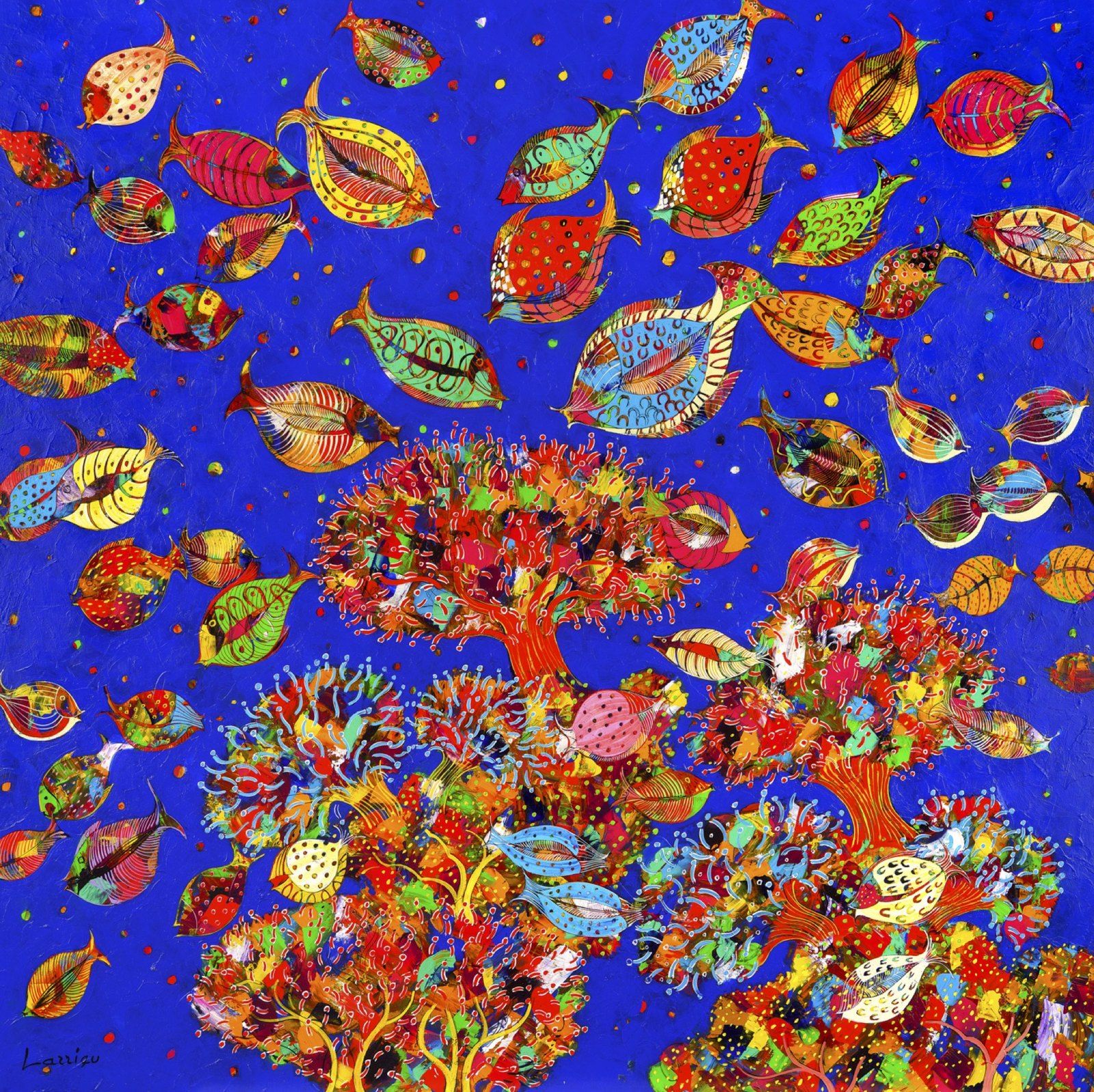
“The ocean, guardian of original beauty” is built around Ocean (2017), a monumental canvas two metres wide in which sea creatures move through a silent choreography. It is the most openly ecological section: beauty becomes an argument for preservation.
“The Tree of Life” is the one the artist himself points to as the heart of his work. The tree links earth to sky, its branches and leaves turning into a luminous city; like fruit ripening, every human being carries within them what they can bring into existence. The large formats are gathered here.
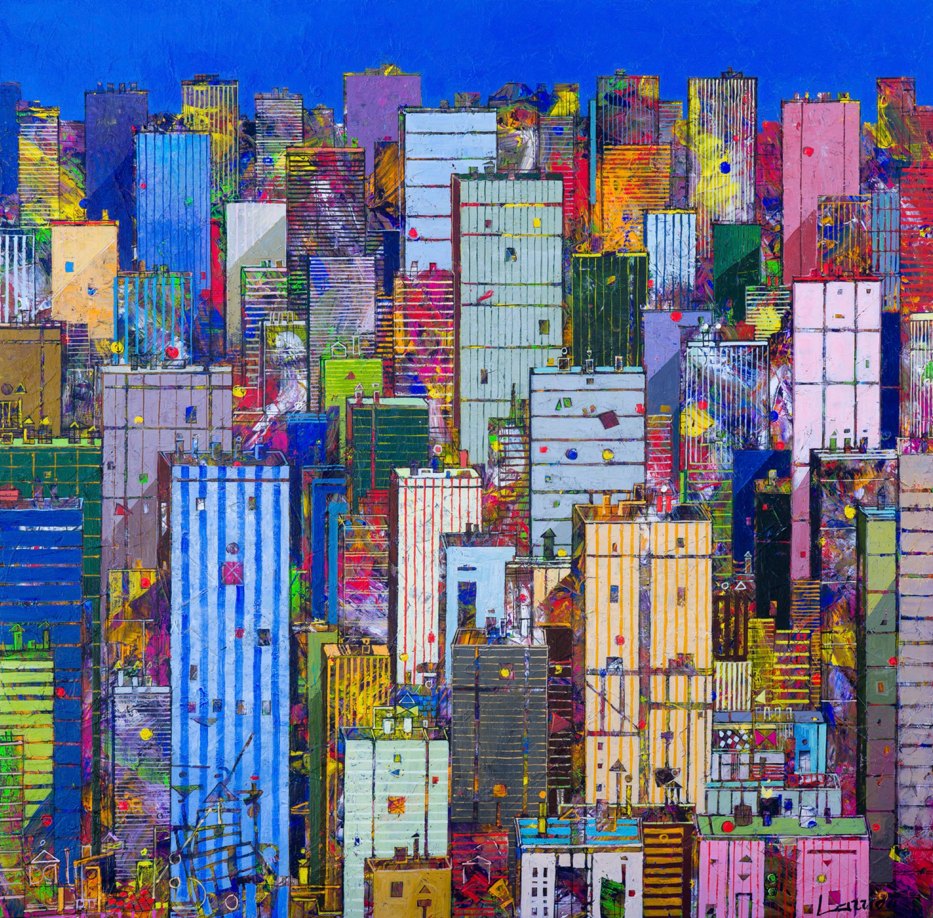
“The vibrant city and the garden of everyday life” closes the sequence. Larrieu’s cities are empty of figures, and yet human life is everywhere in them — in the signs, the motifs, the vibration of colour between the lines of the buildings.
“Art is a real means of passing on humanism, environmentalism and universal values.”
Jean-François Larrieu
The painter and the organiser
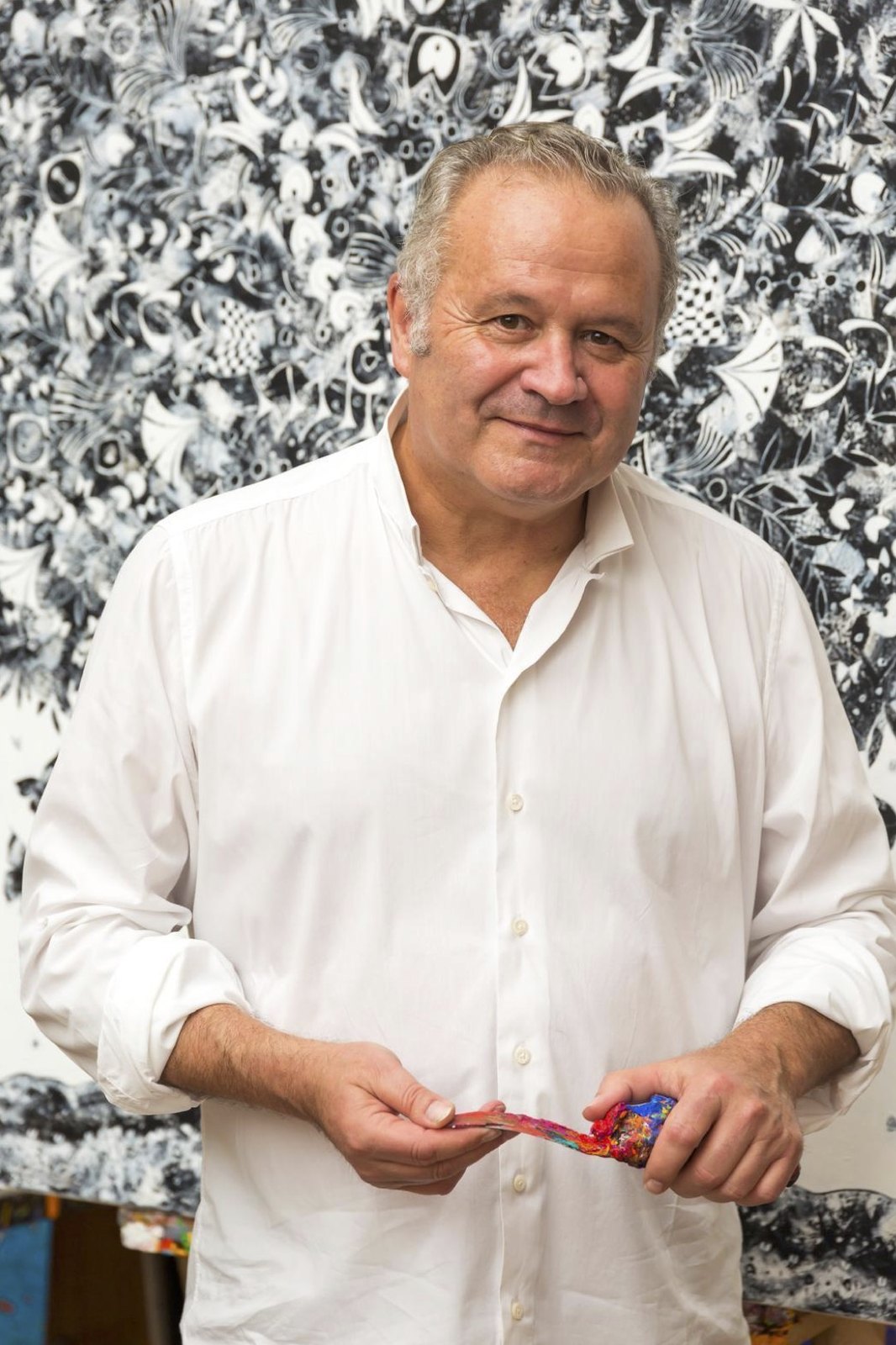
Born in Tarbes on 28 February 1960, Jean-François Larrieu joined the François Villon painting academy at eleven and won its prize the following year. In 1978 he received the painting prize of the Musée Béarnais in Pau, where his first museum exhibition was held — he was eighteen. He moved to Paris in 1982. He now lives and works between Paris and Saint-Jean-de-Luz.
What follows owes as much to collective commitment as to the studio. Co-founder in 1987 of the Grand Palais artists’ defence committee, president of the Salon d’Automne from 1995 to 2004 — it was he who, for the Salon’s centenary in 2003, brought together the descendants of Renoir, Cézanne, Bonnard, Picasso and Picabia for a photograph that has since become a reference — then president of the Federation of Historic Salons of the Grand Palais and co-founder of Art en Capital. Since 2010 he has chaired the Fondation Taylor, one of France’s principal institutions supporting artists.
The consistency is there: just as no form is excluded from his compositions, no artist should be excluded from the art world.
According to the press pack, he was spotted at sixteen by the art dealer Emmanuel David, whose advice — “learn to look, and paint with your heart” — is said to have stayed with him throughout his career. The turning point, though, was more private: the birth of his two sons in the 1990s, the source of the innocence and energy that define the Larrieu style today.
Also according to the press pack, international recognition came quickly. The American collector Azita Toussi is said to have assembled more than a hundred of his works within a few years, going on to open a private museum devoted to the painter in Virginia. The University of Pennsylvania is also said to have dedicated a Master of Fine Arts programme to him, titled “Matisse, Cézanne, Jean-François Larrieu, Masters of Color”.
After Seoul
The artist will travel to Korea in person: a signing session is scheduled for 9 October 2026. The exhibition will not stop at the Seoul Arts Center — it is due to move on to the Moda Museum in Hannam-dong, ahead of a national tour of Korea spread over the following two years.
The editors
ici Biarritz