
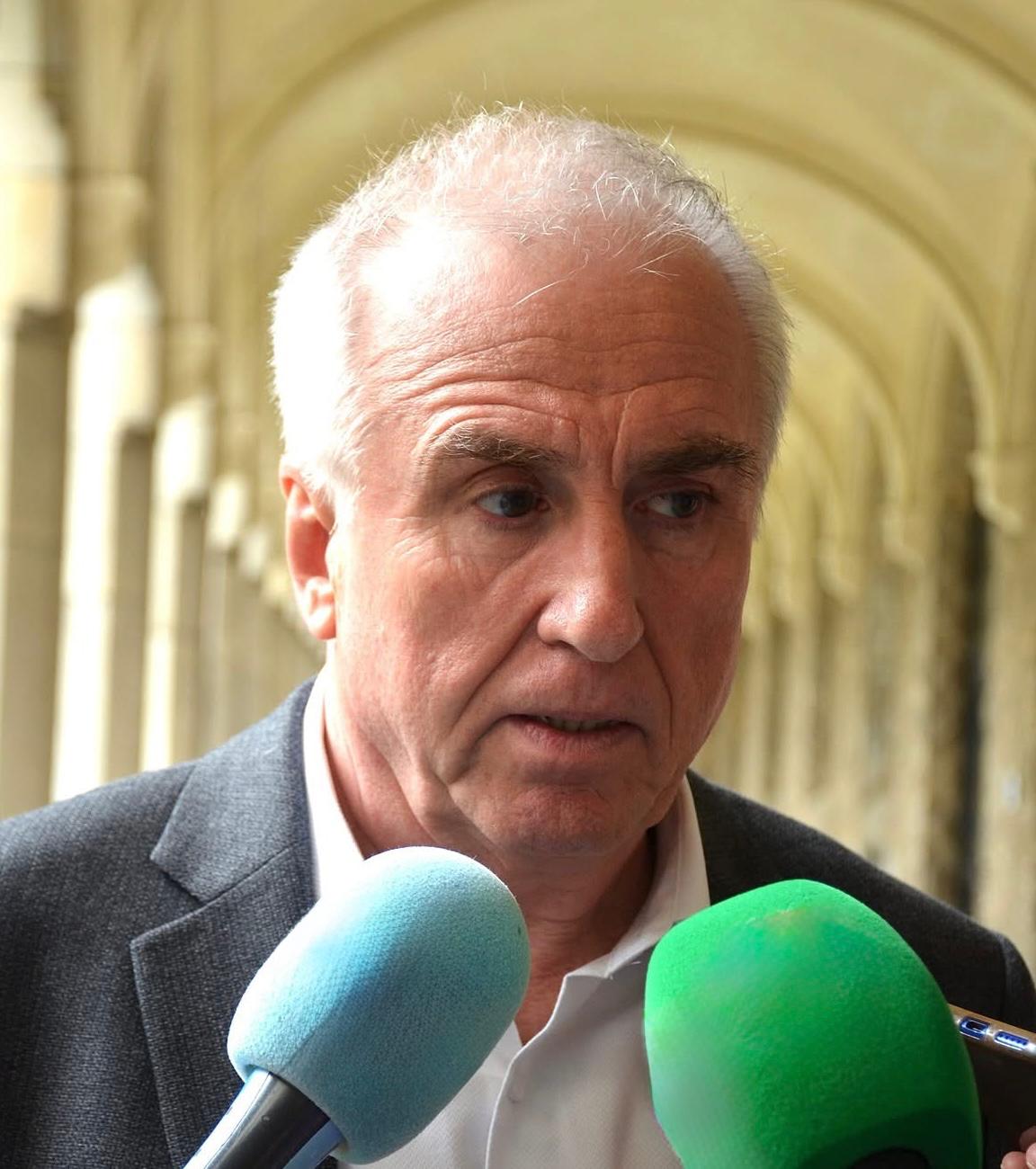
He defeated Jean-René Etchegaray without making a sound, from the small town of Saint-Pierre-d’Irube. Forty years of quiet activism, a network built town by town, and a victory that reshuffles the political deck across the entire Northern Basque Country. A portrait of a politician nobody really saw coming — except himself.
On Saturday, April 11, 2026, in the auditorium of Bayonne’s Cité des Arts, 232 community delegates did something unprecedented: they voted. Not by consensus, not by acclamation. With ballots, envelopes, polling booths. For the first time since the creation of the Pays Basque Community of Agglomeration (CAPB) in 2017, the incumbent president faced a genuine challenger. And for the first time, he lost.
Alain Iriart, mayor of Saint-Pierre-d’Irube, aged 66 and a lifelong abertzale activist, won 119 votes in the second round against 102 for Jean-René Etchegaray. A clear margin, a solid absolute majority — and a stunning political upset for anyone who hadn’t tracked the months of groundwork that preceded it.
| 119 votes in round 2 | 40+ years of activism | 2001 — first election in Hiriburu |
An unknown who was very well known
The press called him “little known to the general public.” That’s true. It’s also, probably, what made him strong. Alain Iriart never sought the spotlight. He sought out mayors. The 158 mayors of the 158 municipalities of the CAPB, whom he visited, listened to, and courted over weeks in what observers immediately dubbed a “third round” — a discreet electoral marathon, conducted with surgical precision, through the sub-prefectures and village halls of the interior.
That is where the key to this election lies: in the fracture between the major coastal cities — Bayonne, Biarritz, Anglet — and the rural municipalities that make up the numerical majority of the community council. Elected officials from the hinterland no longer recognised themselves in Etchegaray’s highly centralised governance. They wanted a greater say. Iriart told them: I am one of you.
“The president must always be the guarantor of unity, cohesion, the institution, solidarity and equity.”
Alain Iriart, CAPB presidential campaign, April 2026
Forty years without making a fuss
His first political engagement dates back to 1986, under the EMA banner — Ezkerreko Mugimendu Abertzalea, the Abertzale Left Movement. A small party, a legislative candidacy with modest results. But a beginning. Since then, Iriart never wavered: Abertzaleen Batasuna, then EH Bai from the coalition’s founding. A departmental councillor in 2008 without party affiliation, re-elected in 2015 under EH Bai, he resigned in 2017 to join the vice-presidency of the newly formed CAPB — already refusing to hold multiple mandates simultaneously.
At the CAPB, he took over the presidency of Bil Ta Garbi, the waste processing authority, in 2013. A thankless, technical, unglamorous brief — but one where he built a reputation as a rigorous and innovative manager. It was that work, far from the cameras, that allowed him to forge ties with elected officials of all political persuasions, well beyond the abertzale left.
| PROFILE | |
|---|---|
| Born | July 27, 1959, in Saint-Pierre-d’Irube |
| Mayor | Saint-Pierre-d’Irube / Hiriburu since March 25, 2001 (5 terms). Basque speaker. |
| Family | Father of two sons, grandfather of two granddaughters |
| Party | EH Bai — Bil Gaiten group at the CAPB |
| Elected | April 11, 2026, with 119 votes out of 232 (absolute majority) |
| Commitment | Will resign as mayor to devote himself 100% to the presidency |
What this vote really means
It would be reductive to read this election as a simple protest vote against Etchegaray. The mayor of Bayonne remains a respected figure — and he acknowledged it himself, wishing his successor good luck with a grace that does him credit. What unfolded on April 11 was something deeper: a rebalancing of the CAPB’s political centre of gravity.
The rise of the abertzale left at the last municipal elections — with more EH Bai councillors in town halls, and therefore more delegates to the community assembly — created a critical mass sufficient to tip the balance of power. Peio Etxeleku (EAJ-PNB) obtained only 48 votes in the first round. His withdrawal in the second round, accompanied by a personal call to vote for Iriart, did the rest. A tacit rapprochement between the two abertzale families that EH Bai hastened to clarify constituted “no formalised agreement.” The nuance is political. It fools no one.
Reactions from the Southern Basque Country are telling. Lehendakari Imanol Pradales sent his congratulations and proposed enhanced cooperation. Arnaldo Otegi welcomed the fact that “the Basque Country now has three presidents” — PNB, PSN and EH Bai — as if Iriart embodied a new dimension of a political project that extends far beyond France’s administrative borders.
The question that remains open
Alain Iriart takes the helm of a young institution, still fragile in its internal balances, facing considerable challenges: real-estate pressure and housing on the coast, the climate emergency, the linguistic question of euskara, and demographic growth transforming the territory at a relentless pace.
His line is clear: decentralise, return initiative to mayors, govern by consensus rather than by diktat. It’s an appealing method. But governing 158 municipalities with often conflicting interests, in a national context of deep institutional crisis, sometimes also requires making tough calls. The real question is not whether Iriart can unite — he proved that on April 11. It is whether he will be able to decide.
The coming weeks will tell: the appointment of his team of vice-presidents and the allocation of portfolios will be the first real test of the governance he has promised. A careful balance — geographic (coast versus interior) and political (right, centre, abertzale) — that will be closely watched by the 158 mayors who crowned this quiet man from Hiriburu.
Zilbor | Chronicles & analysis — Ici Biarritz