
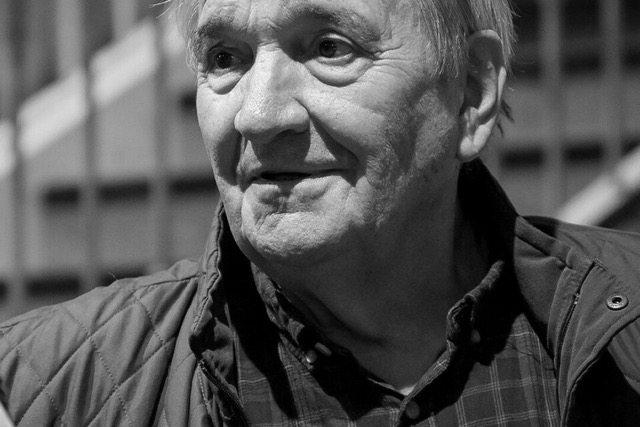
There are departures that make noise. And others that compel silence.
Claude Castex’s departure belongs to the second kind.
Not because it is lesser — quite the contrary — but because it brings us back to a kind of truth our era struggles to face: the value of those who never seek the spotlight.
Claude Castex was neither an elected official in office nor a public figure. He had nothing to sell, nothing to prove, nothing to conquer. And yet, he was there.
I had the chance to meet him in Biarritz, at the Bellevue, at the closing rally for Jean-Baptiste Dussaussois Larralde just a few days before his passing. A full room, a palpable tension, that suspended moment when politics stops being strategy and becomes what it should always be: a human affair.
In that crowd, he simply stood present. We exchanged a few words. Nothing extraordinary on the surface. But there was something rare in his presence: a quality of attention, a complete absence of posture.
And that remark, almost casual, yet saying everything: it was his fourth rally of the week.
Fourth.
At a time when so many political figures calculate their appearances, optimise their visibility, and stage their commitments, he persisted in a form of loyalty that felt almost old-fashioned.
A loyalty without witness.
Without staging.
Without expectation of return.
Claude Castex belonged to a generation for whom commitment is not proclaimed — it is practised. A teacher by training, deeply shaped by a culture of transmission, he had very early on anchored his path within the collective. In Vic-Fezensac, he threw himself into sport and community life, presiding over the Union athlétique vicoise, before continuing that engagement in the Basque Country.
At the Saint-Jean-de-Luz Olympique Rugby club, where he served as vice-president, he was one of those figures who don’t take the floor to exist, but whose presence is enough to hold things together. A pillar, in almost the literal sense of the word.
The son of a former mayor and senator, the father of a Prime Minister, he could have existed in the shadow cast by those offices, drawn on them, used them as a source of legitimacy. He chose the opposite.
To step back in order to better support.
To hold back in order to let others exist.
To be present without ever weighing on anyone.
When his son was appointed to Matignon in 2020, he spoke, with disarming simplicity, of a father’s pride. A raw emotion, without calculation — the image of the man he was. Settled in the Basque Country, he had chosen his territory — not as a retirement backdrop, but as a real space of engagement, close to others.
A reliable man. A man of his word. A man of connection.
In a world of politics increasingly saturated by visibility, immediacy, and the competition of egos, Claude Castex embodied another path — demanding, because it brings nothing in apparent return, because it confers no title, no status, no immediate recognition. But an essential path.
For politics does not hold only through those who decide. It holds too — and perhaps above all — through those who accompany, who stabilise, who make things possible. Claude Castex was one of those. He belonged to that invisible architecture without which no collective construction holds over time.
His passing, which came in the night of 31 March, and his funeral held a few days later at the Pavillon Bleu de Kechiloa — the ground he had helped bring to life — remind us, with an almost brutal sobriety, that the most honest trajectories are not always the most visible.
In an era that prizes exposure, he reminds us of the power of presence.
In a world that often confuses importance with visibility, he shows us that what matters lies elsewhere.
In a time that accelerates everything, he embodies the patience of connection.
There is, in this way of being, a form of dignity. A dignity of the shadows.
Claude Castex never sought to be a figure. But in his passing, he compels us to look differently at those who, without ever appearing, hold the line. And that, today, is perhaps worth more than many speeches.
— Zilbor
Photo credit: © Saint-Jean-de-Luz Rugby Club