
Living Biarritz · Local farming
On Friday 3 July, in the rain, Bidart and Biarritz broke ground on Erroberri, their shared market-garden farm. On 4.5 hectares of public land returned to farming, the municipally run operation will soon cover 80% of the vegetable needs of both towns’ canteens, all organic and irrigated solely by its own rainwater. The story of a worksite that says a great deal.
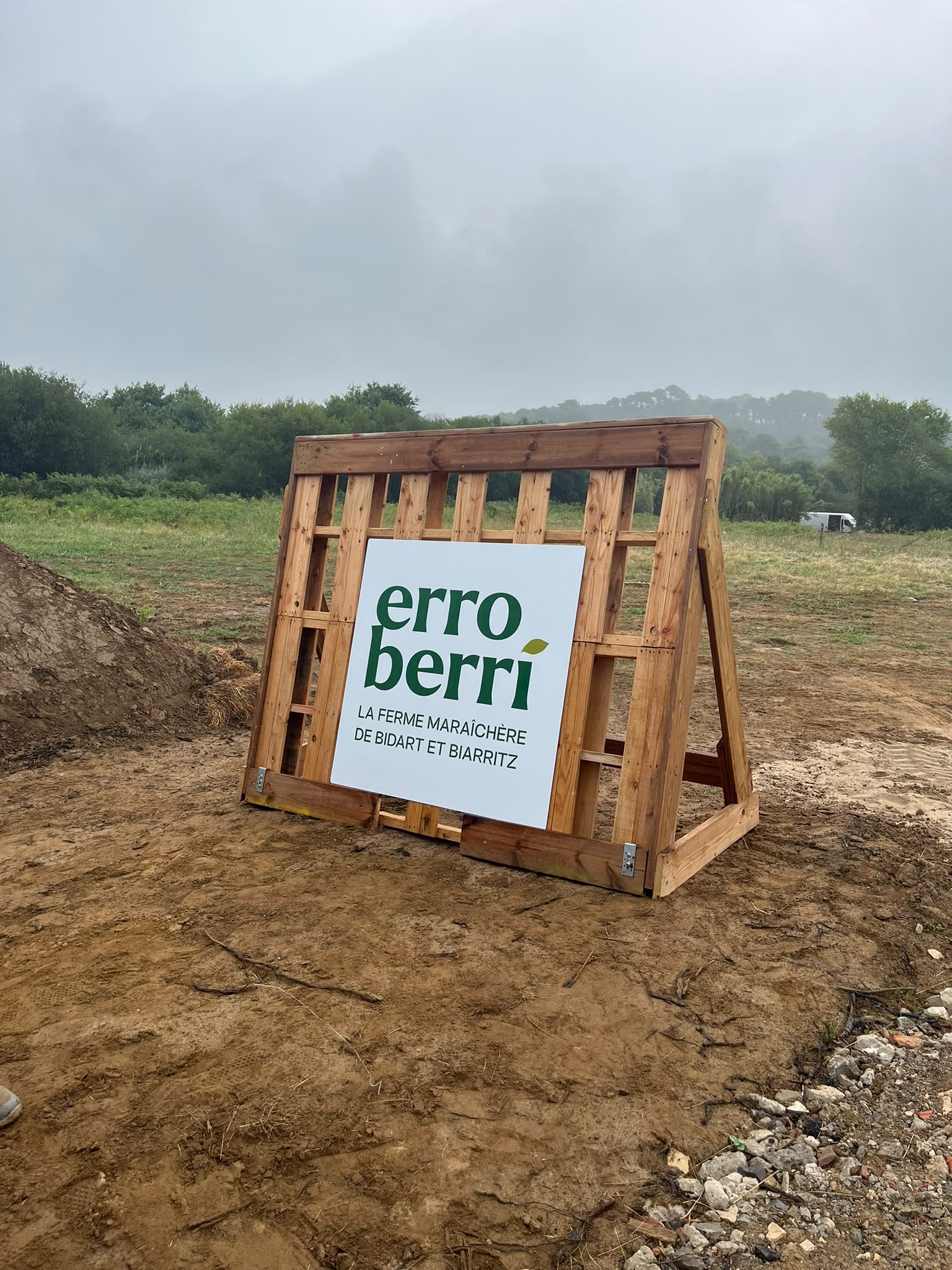
ILBARRITZ — On Friday morning, that fine rain that clings to your boots was coming down. On a clay plot wedged between Lac Mouriscot and the golf course, the mayors of Bidart, Emmanuel Alzuri, and of Biarritz, Serge Blanco — the latter accompanied by his deputy for the Environment and the Coastline, Jean-Baptiste Dussaussois Larralde — surrounded by Julien Duflo, chief executive of Bidart’s municipal services, and a handful of journalists who turned up despite the weather, gathered around a pale wooden sign: erro berri — the market-garden farm of Bidart and Biarritz. This is where the work was launched. Nothing spectacular: a concrete slab, handshakes under umbrellas, a site still covered in freshly turned earth. And yet what begins here says something about our times.
Erroberri — “new root,” in Basque. The name was not drawn at random. On these 4.5 hectares of public land long nibbled away by urban development, then left to brambles and pampas grass, two towns have decided to grow vegetables again.
Taking back control of the plate
The reality is prosaic. Every year, Biarritz and Bidart together prepare hundreds of thousands of meals for their schools, nurseries, leisure centres and care homes for the elderly. Since the EGalim law, they have had to include sustainable and organic food — but finding organic vegetables grown nearby, in volume and all year round, is increasingly a headache. Farmland along the coast is counted in acres lost; in the Basque Country, the equivalent of several farms is erased every year.
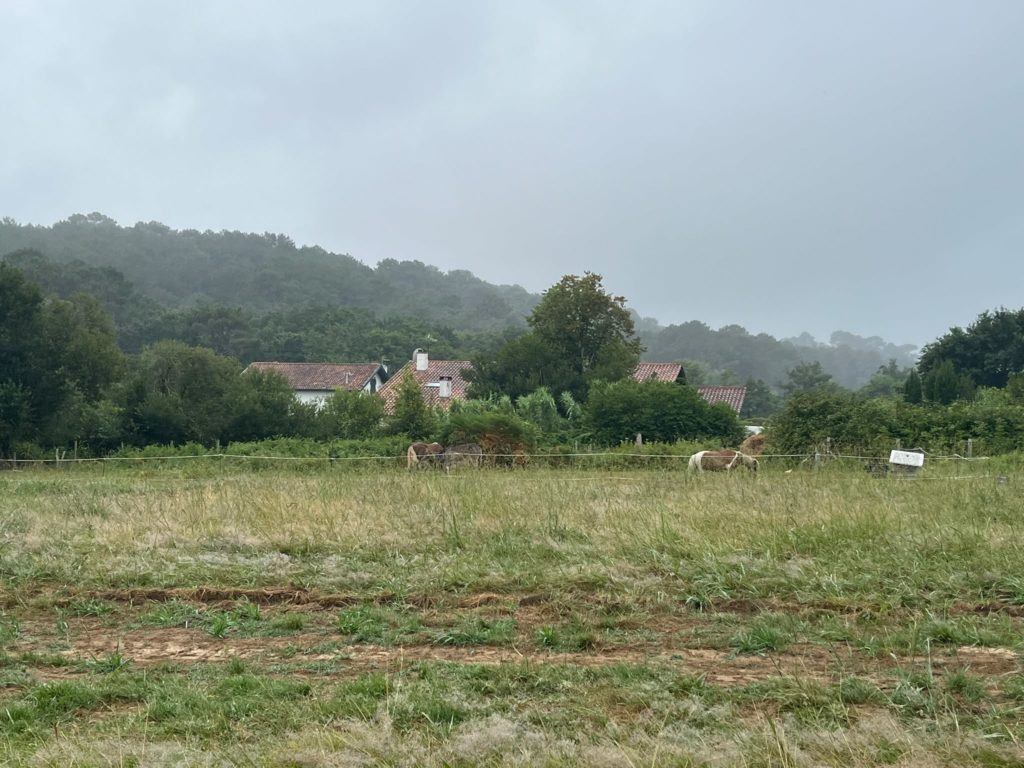
Between Basque meadows and farmhouses, the Ilbarritz land returned to farming. © Ici Biarritz
Hence the idea, simple and almost anachronistic: produce it yourself. Erroberri will be run directly as a public operation, legally held by the town of Bidart and shared with Biarritz within the SIAZIM, the joint authority that manages this Ilbarritz-Mouriscot area straddling the two towns.
The figures spell out the ambition. At full production, expected around 2028, the farm is to yield 25 tonnes of vegetables a year — the equivalent of roughly 350,000 meals — and to cover 80% of the vegetable needs of the two central kitchens. Of the 4.5 hectares, one and a half will be grown in open fields and 2,000 m² under greenhouses, to ensure a diversity of harvests. A 250 m² operations building, whose main structural work has just begun, will house cold rooms, storage, a technical workshop and space for staff. On its roof, photovoltaic panels: enough to power the farm and even a few municipal buildings. A farm manager has just been hired; an agricultural worker will assist him. All of it organic, without exception.
Water first
It is perhaps the most discreet detail of the site, and the most telling. Behind the sign, a vast black tank is already taking shape beneath its membrane: a rainwater-collection basin of 1,500 m³ over 900 m² of surface, currently being waterproofed. It is meant to give the farm nearly three months of autonomy without a drop of rain — a choice made with increasingly dry summers in mind, as heatwaves take hold.
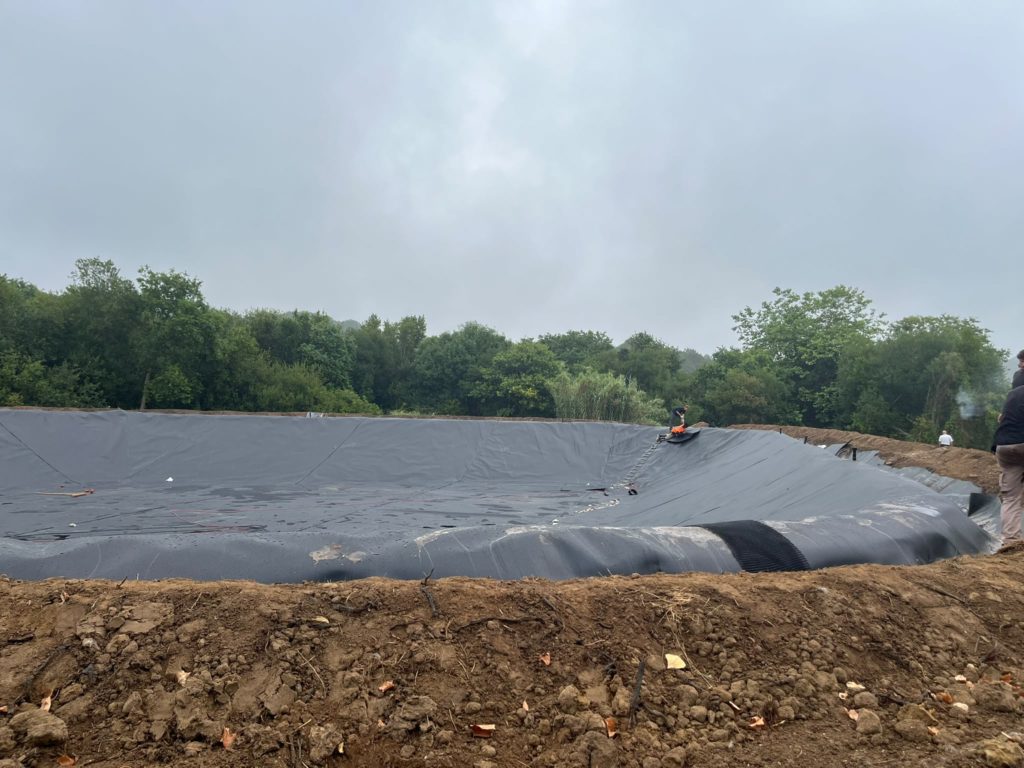
The 1,500 m³ basin, being waterproofed: the farm will irrigate without drawing on the mains. © Ici Biarritz
It is this aspect, that of water and resources, that most concerns Jean-Baptiste Dussaussois Larralde, deputy for the Environment and the Coastline in Biarritz:
A farm that lives off its own rain, on a coastline where water is becoming an issue, is the kind of restraint we need to learn to build.
Jean-Baptiste Dussaussois Larralde, deputy for the Environment and the Coastline, Biarritz
A project older than its signs
It has to be said: Erroberri was not born on Friday. The idea of bringing farming back to this stretch of heath matured over many years. Residents, associations and farmers had dreamed of it; the services of Bidart and Biarritz carried it forward, file after file. The project will have spanned successive mandates, changed shape, waited patiently. What is happening today is therefore not an invention: it is a culmination. And we know, in the Basque Country as elsewhere, that the projects that matter are rarely the ones that get announced, but rather the ones seen through to the end.
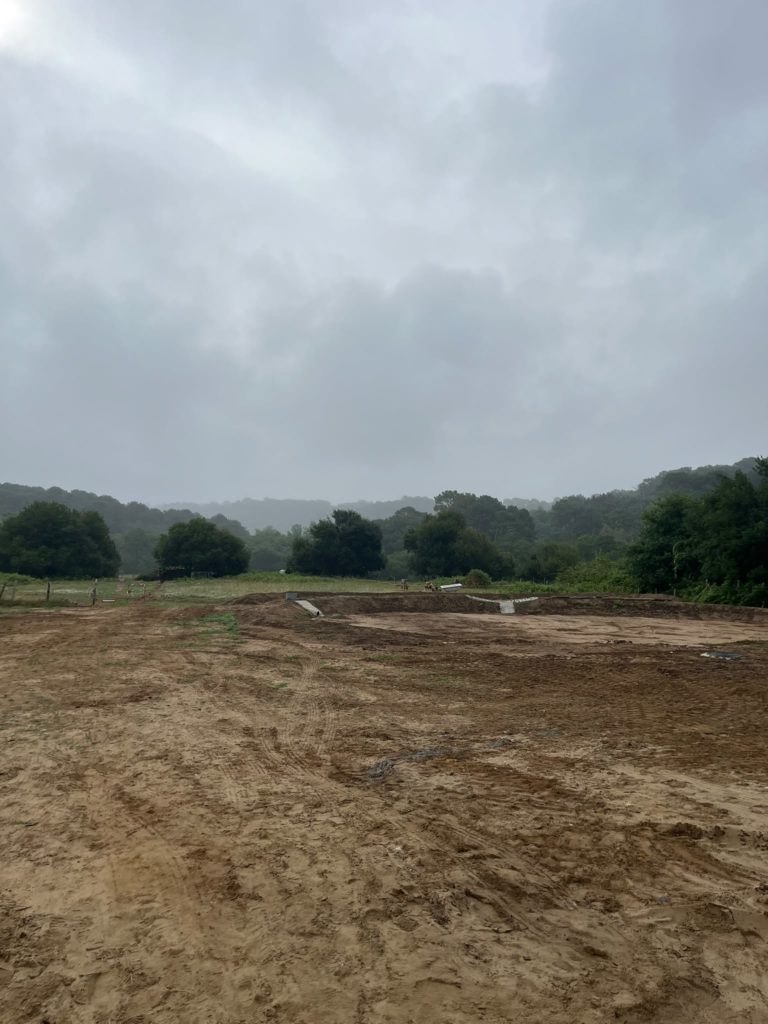
Across 4.5 hectares, the site development works are under way. © Ici Biarritz
The first plantings are expected in the autumn; full production, however, will not come before 2028. Until then, season after season, with its failures and its successes, Erroberri will also serve as a teaching tool: schoolchildren will be able to come and see how their carrots grow, somewhere other than in a plastic bag.
In Friday’s rain, all of this still felt distant. But the first root is in the ground. We will come back to watch it grow.
Zilbor
zilbor@pm.me
The ici Biarritz shop selection
Grow & cook local — in the spirit of Erroberri.
- Start a vegetable garden — organic seeds and a kitchen-garden guide. See selection →
- Cook seasonal vegetables — a book to make the most of local produce. See selection →
- Rainwater collector — to water like Erroberri, season after season. See selection →
As an Amazon Associate, ici Biarritz earns from qualifying purchases. This doesn’t change the price you pay.