
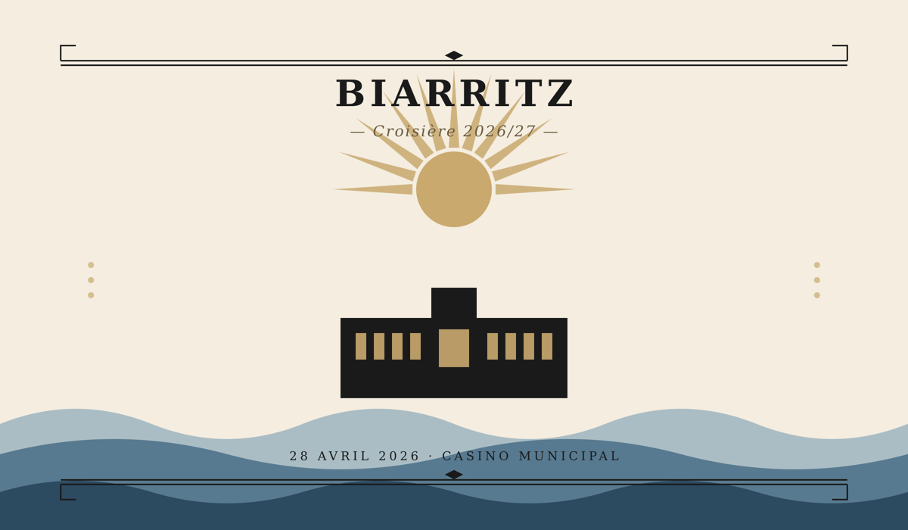
Original illustration — Ici Biarritz, 2026
On 28 April, Matthieu Blazy presented his first Cruise collection for Chanel at the Casino municipal. One hundred and eleven years after Gabrielle Chanel opened her very first couture house on rue Gardères, the house of the double C has returned to its founding ground. Reportage, analysis, and a view from street level.
A return that was no postcard
Chanel’s Cruise 2026/27 show can be read as a global communication operation set down for a few hours on the Basque coast. That would be accurate, and insufficient. Because behind the choreography of tinted-window saloons and black suits on the Casino forecourt, there was, on this Tuesday 28 April, something more singular: a French luxury house publicly rewriting its own narrative, and choosing Biarritz as its origin page.
It was in 1915, in the Villa de Larralde, a stone’s throw from the Grande Plage, that Gabrielle Chanel set up her first couture house worthy of the name — boutique, ateliers, salons, apartment, all under a single roof. Before Paris, before rue Cambon, before the myth: Biarritz. The city was no backdrop, it was the laboratory of a stylistic revolution founded on freedom of movement, comfort, fluidity — what menswear had practised for a long time and what women were waiting for. One hundred and eleven years later, Matthieu Blazy, 41, appointed artistic director in late 2024 after Virginie Viard’s departure, picks this starting point to sign his first Cruise show.
The gesture is clear: to allow himself to move Chanel, Blazy starts by returning to where Chanel began.
The Casino transformed, the ocean as backdrop
The hall of the Casino municipal — an Art Deco building Biarrots barely frequent — was unrecognisable. Mirror-faceted walls, plays of light, ocean-overlooking bay windows turned into a natural screen: the house took over the venue for two successive twenty-minute shows, allowing it to host its nine hundred guests without compromising the experience. Seventy-nine silhouettes — eighty according to some counts — paraded before an audience mixing the house’s historic ambassadors, international celebrities and local figures.
The collection itself deserves dwelling on, because it says a great deal about the direction Blazy is giving Chanel. The designer has freed himself from the hierarchical codes dear to the house: workwear and leisurewear, sailor’s uniform and evening dresses, functional wardrobe and mermaid imaginary all coexist on the same runway. The Basque stripe — an avowed nod to the territory — runs through it as a connecting thread. The tweed is there, the camellia too, but reworked under a new tension between structure and looseness, where Chanel had long rested on an almost rigid grammar.
For sector analysts, the stake was twofold: confirm the creative breath already perceptible in Blazy’s first ready-to-wear collections, without losing the clientele attached to the historic codes. A tightrope position. The commercial verdict will come in November, when the collection arrives in store, but the signal sent is clear: Chanel will no longer be quite the same house.
« 1915 · 2026 » — original illustration, Ici Biarritz
Why Biarritz, and why now
Choosing Biarritz isn’t choosing a destination — it’s activating a narrative. After Monaco, Los Angeles, Marseille, and last year Lake Como, the city joins the list of Cruise stopovers. But unlike most of those stages, Biarritz isn’t an exotic backdrop: it’s a matrix. Bruno Pavlovsky, president of the house’s fashion activities, said as much on the sidelines of the show: the recent acquisition of the Villa Larralde, the opening of a new boutique on rue Gardères since 23 April, and the partnership with the Nouvelles Vagues festival testify to an attachment that goes beyond the one-off operation.
For Biarritz, the operation reads on several levels. Symbolically, the city is internationally consecrated as the cradle of Chanel style — a narrative now circulating through fashion newsrooms worldwide. Economically, the event mobilised florists, food trades and local craftspeople, as confirmed by Thomas Ambrot, third deputy mayor in charge of communication and major events, who speaks of « strong impact for the city’s standing ». The Coco Beach pop-up boutique, open on rue Gardères until 27 September, will extend the commercial presence to the end of summer.
On the urban plane, however, the event also reminded us, concretely, what the arrival of a luxury house in town weighs. Two streets closed above and below the Casino, a secured corridor for official vehicles to circulate, barriers keeping Biarrots at a respectful distance from the buzz. « It’s incredible to see this here », slipped a resident to the daily Fashion Network. « It has a slight G7 feel », added another. The comparison isn’t trivial in a city that hosted the 2019 summit and which has known, since then, what the interlocking of world event and urban fabric produces.
The Biarrots, the barriers, and the black ballet
Here, then, is the point that deserves, at Ici Biarritz, to be dwelled on more than the Parisian magazines have. While nine hundred handpicked guests entered the Casino, and around a thousand other lucky lottery winners watched the big-screen projection at the Gare du Midi, passing Biarrots and downtown residents, for the most part, made do with a more modest spectacle: that of the black saloons, the Mercedes vans and the furtive silhouettes crossing the barriers.
It is neither a scandal nor a surprise — it’s the very format of a Cruise show, which has never been intended as a public event. The house did things « in good understanding with the municipality », in the terms used by Fashion Network. But this mechanism poses, in negative, a question that goes beyond the event: what is the place of the Biarrot in a city that has become, according to a formula already taken up by the trade press, the « capital of luxury »?
The question calls for no unilateral answer. International standing, returns for hoteliers and craftspeople, the durable presence of a house buying back heritage and maintaining it — all of that counts. Closing two streets for a few hours, and the feeling of watching from the pavement a spectacle from which one is excluded, count too. The job of a local newsroom is not to settle things too quickly, and to keep both realities in the same sentence.
And then?
What remains is to know how this anchorage will continue. The Villa Larralde has been acquired — for what project, on what horizon? The pop-up boutique closes on 27 September — what will happen next to those historic premises on rue Gardères? Is the partnership with the Nouvelles Vagues festival meant to broaden? So many sites which, if they take shape, would turn a spectacular show into a durable presence. And which, conversely, if they remain in suspense, would bring the event back to what it could have been only in part: a superb communication page.
On 28 April 2026, Biarritz offered itself to Coco, and Coco returned the favour. What follows is now written by the year, no longer just by the evening.
Zilbor

SIDEBAR — All-Biarritz and all-the-world at the Casino
The show’s casting, as always at Chanel, mixed international faces and figures from the territory — the house taking care to balance global standing and local roots.
Ambassadors and muses: Nicole Kidman, Marion Cotillard, Tilda Swinton accompanied by her daughter Honor, Sofia Coppola, Anamaria Vartolomei, Anna Mouglalis, Ana Girardot, Charlotte Casiraghi (appearing in a white plastron shirt embroidered with a Chanel in red italic letters), the writer Anne Berest, the filmmaker Ramata-Toulaye Sy, or actresses Michaela Coel and Barbara Lennie.
New ambassadors: A$AP Rocky, recently brought into the Chanel galaxy, arrived with a bubble-gum pink canvas bag adorned with mini ballerina shoes on his arm. Model Paloma Elsesser, blogger Bryan Boy, Japanese actresses Nana Komatsu and Miu Natsha, model Lena Schuett.
On the local side — and this is where the house took care of its Basque landing: former football international Bixente Lizarazu, accompanied by his brother Peyo (in a sleeveless shirt with summer prints), skaters Vincent Milou and Lucas Puig, rugby players Rémi Bourdeau and Yann David, surfers Kyllian Guerin and Édouard Delpero. The presence of these figures from local board sports, rather than only Parisian faces, isn’t anecdotal: it speaks of Chanel’s will to weave a link with contemporary Basque imagination — that of boards, the open sea, the waves — and not only with the 1915 postcard.
Some stars are said to have arrived discreetly via the Grande Plage car park. The exhaustive list, in fashion as in politics, never exists.
Article published in Ici Biarritz — your independent media of the Basque Country
CREDITS
Illustrations: original creations for Ici Biarritz, inspired by the aesthetic of Art Deco seaside posters (1925-1935).
• Cover: « Biarritz, Cruise 2026/27 » — Casino Municipal and Grande Plage composition.
• Section: « 1915 · 2026 » — stylised waves and Basque sun, echoing the house’s return to its founding ground.
• Sidebar banner: Art Deco ornament — radiating fan and ornamental fillets.