
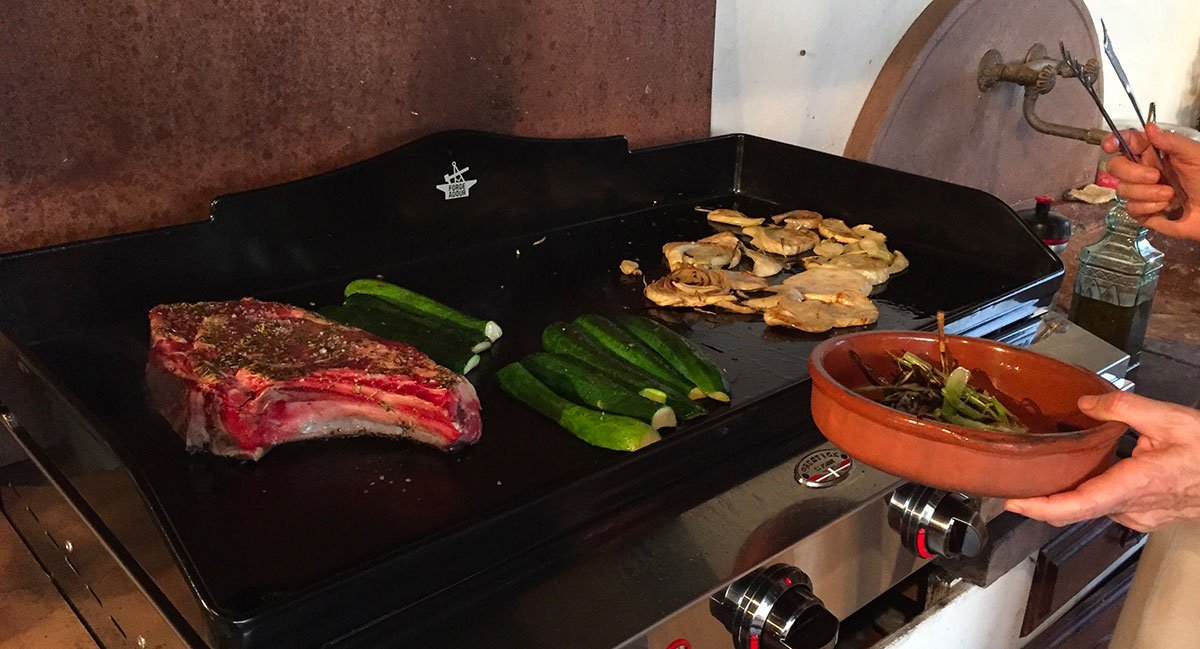
Here, the plancha is no summer gadget. It is the centre of gravity of family Sundays, of aperitifs that stretch on, of trips home from the market. Before choosing one, it pays to understand what sets a good machine apart from a purchase you regret at the very first squid. Our guide, no detours, to kitting yourself out like a true local — with a brand born just down the road.
By the ICI Biarritz editorial team — Guide
Gas or electric: the first real question
It all starts here. The gas plancha remains the benchmark for outdoor use: fast heat-up, high power, and that ability to sear a tuna steak or a duck breast without the temperature dropping when you load the plate. It is the choice of those who cook for the whole table, on the terrace, all year round. You will need a butane or propane bottle and a bit of space.
The electric plancha, for its part, has earned its stripes. Simpler to set up (a socket is enough), it suits balconies, small terraces and even indoor use. Its heat-up is a little slower and its power lower, but for two to six guests it does the job perfectly. It is also the answer when you would rather not deal with a gas bottle.
Our advice: if you entertain often and have space outdoors, go for gas. If you cook for two or the terrace is small, the electric model will satisfy you without taking up room.
The plate: enamelled cast iron or stainless steel?
This is the heart of the plancha, and the criterion that often justifies the price gap. Enamelled cast iron spreads the heat evenly, holds a steady temperature even when you add cold food, and is easy to clean. It is the most versatile and most durable choice for family use.
Stainless steel appeals through its contemporary look and its sturdiness, but demands more skill: the heat can be less even and the upkeep more exacting to avoid marks. Best left to those who already have the knack, or who prize the looks of a designer outdoor kitchen.
A good enamelled cast-iron plate, well looked after, can last twenty years. It is the kind of investment you hand down.
What size for how many guests?
Simple rule: gauge the plate width by the number of people you usually host. A 45 cm plate is enough for two to four guests, 60 cm covers a family table of four to eight, and 75 cm or more is for those who feed ten people or more. Better to go a little big: a plate that is too small forces you to cook in several rounds, and the plancha aperitif loses all its point when the cook is left alone at the stove.
Forge Adour, the choice that comes from here
Impossible to talk planchas in the South-West without mentioning Forge Adour. Born in Bayonne in 1978 and still rooted in the Basque Country, the brand has established itself as a European benchmark for the plancha. Originally a specialist in fireplace accessories, the family firm made the plancha its core business and popularised this art of cooking outdoors well beyond our borders.
Let us be precise, because the nuance matters: Forge Adour designs its products in France, in the Basque Country, but now manufactures them in Spain, in Villafranca de los Barros. So it is not a “made in Bassussarry” plancha, but a deeply Basque brand, whose enamelled cast-iron plates and long warranty (up to fifteen years depending on the range) built its reputation. Several collections coexist — from entry-level models to sleeker premium versions — in gas as well as electric.
To find your way, you can compare the Forge Adour planchas by plate size and power type, then round things off with a dedicated trolley to free up your worktop and move the whole thing out onto the terrace.
The accessories that change everything
A plancha without its kit is like a car with no petrol. Three essentials:
- The spatulas: get two, angled, to flip and gather without burning yourself. It is the tool you reach for at every cook.
- The scraper and a cleaning blade, to lift the caramelised juices while hot and keep the plate spotless.
- The protective cover: essential against the sea air and coastal damp, which are quick to attack an appliance left outside.
Add a suitable cleaning product for enamelled cast iron, and your plancha will follow you for years without flinching.
Upkeep, the secret to longevity
The ritual is simple and comes down to a habit: deglaze the still-hot plate with a little water or a few ice cubes, scrape the residue towards the grease tray, wipe, then run a film of oil over it to protect the cast iron. Never an abrasive product on the enamel. That is the price at which a plancha sails through the summers without losing its lustre — and ends up gathering what no new one has: the memories of the tables that came before.
ICI Biarritz
This article contains affiliate links. As an Amazon Associate, ICI Biarritz earns from qualifying purchases, which helps support our editorial work at no extra cost to you.