
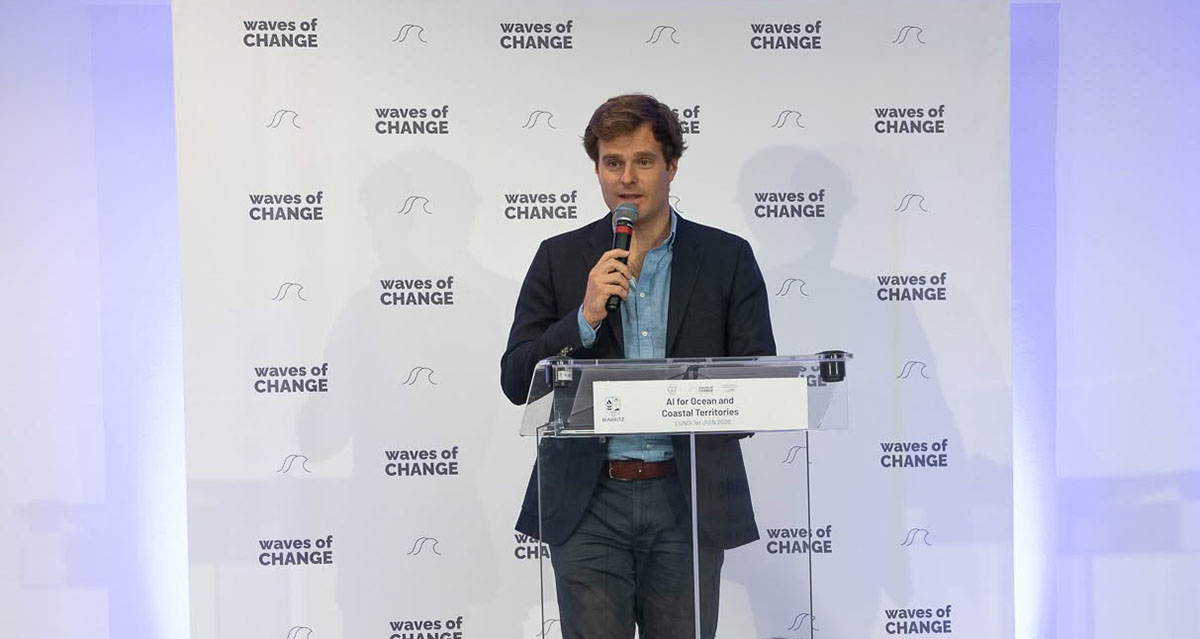
At the Waves of Change 2026 forum, the City of Biarritz formalised its membership in the Coalition for Sustainable AI. That commitment was carried on the ground by Jean-Baptiste Dussaussois-Larralde, first deputy mayor for the environment, who represented the Basque city alongside Cascais, Santa Cruz and Yoff.
A membership announced at the Waves of Change forum
It was Vincent Jéchoux, regional director for the environment of the Nouvelle-Aquitaine Region, who announced the City of Biarritz’s entry into the Coalition for Sustainable AI, during the Waves of Change forum held in Biarritz from 1 to 3 June 2026. On site, it was Jean-Baptiste Dussaussois-Larralde, first deputy mayor for the environment, who represented the municipality.
Jean-Baptiste Dussaussois-Larralde, the voice of Biarritz at the international table
Beyond the signature, it was in the discussions themselves that the deputy mayor flew the city’s colours. Jean-Baptiste Dussaussois-Larralde took part in the workshop “Coastal cities, sustainable AI and the ocean”, alongside representatives of Cascais (Portugal), Santa Cruz (California) and Yoff (Senegal).
Three cities, three continents, one shared horizon: the ocean. For Biarritz, whose entire identity is bound up with its coast, this is no abstract matter. Seeing an elected official from our town take a seat at that table, and raise the question of the coastline there, is a reminder that the great global debates on artificial intelligence also play out at the level of our beaches.
A coalition born in Paris
Initiated by the French State, the Coalition for Sustainable AI was launched in February 2025 at the international AI Action Summit in Paris, under the aegis of France, the United Nations Environment Programme (UNEP) and the International Telecommunication Union (ITU). It brings together governments, industries, research institutions and civil society around a common goal: aligning the development of artificial intelligence with global environmental objectives.
Two principles for a sustainable AI
The concept rests on a dual dimension, summed up by its initiators as “green AI” and “AI for the environment”.
The first strand aims to reduce the footprint of AI itself. Training and running these models consumes enormous resources — electricity, water, raw materials. The idea is to design more frugal systems that build in, from the outset, a set of principles meant to limit that consumption. To make these efforts measurable and comparable, more than thirty public and private partners have drawn up a first international roadmap for assessing the environmental impact of AI, and the International Energy Agency has launched a global observatory to anticipate the energy needs of data centres.
The second strand, conversely, harnesses AI as a tool serving the environment: climate modelling, management of ecosystems and resources, optimisation of energy consumption or monitoring of deforestation.
The ocean, the coalition’s new frontier
This is precisely where Biarritz has its place. At the United Nations Ocean Conference, the coalition launched a dedicated strand, “AI & Ocean”, to bring together researchers, local authorities, innovators and funders around the preservation of marine ecosystems. The workshop on “Coastal cities, sustainable AI and the ocean”, in which Jean-Baptiste Dussaussois-Larralde took part, fits into this dynamic: putting technology at the service of a coastline that, here, is part of our daily life as much as our identity.
And what about the people of Biarritz?
Let’s be clear: joining a coalition is, first of all, a commitment in principle. No budget and no project follow automatically from a signature. What will count is what the city makes of it.
The local stakes, though, are very real. Our cliffs are receding, and the Côte des Basques is the subject of costly, repeated reinforcement works with no guarantee of halting the erosion. If sustainable AI is to mean anything for Biarritz, this is where we expect it: monitoring and anticipating the shoreline, tracking bathing-water quality, managing energy better. In the conditional, for now.
One paradox should not be brushed aside: presenting as “green” a technology that devours electricity, water and raw materials. The real success of this membership will be measured in deeds, not in a forum photo. We will come back to it.
Learn more: greentechinnovation.fr
The editorial team