
Event · Basque culture · Practical guide
When
15 → 19 July 2026
5 days & 5 nights
Where
Bayonne — Grand & Petit Bayonne, the quays
Dress code
White, red neckerchief & sash
Access
Free Wed.–Thu.
€15 from Friday 10 am
There’s a geographical justice few guides point out: the Fêtes de Bayonne begin, in a sense, in Biarritz. On the opening Wednesday, the Foulée du Festayre — in its 25th edition this year — sets off from the Côte des Basques and, via Anglet and the banks of the Adour, reaches the historic heart of Bayonne. The festival’s first step is thus taken barefoot on Biarritz sand, before ending in white and red in the old town. A reminder that, on this coast, you don’t go to the fêtes as you’d go to a show: you step into them.
The rest comes down to a few markers, which this guide sets out to make crystal clear. Because behind the picture-postcard image — the bandas, the giants, the endless night — the Fêtes are also a piece of machinery: dates, a wristband, bus times, a dress code. Well prepared, they’re all the better for it.
What to remember for 2026
First things first: get the dates right. The 2026 edition runs from Wednesday 15 to Sunday 19 July, a little earlier in the summer than in years past — a detail that matters when booking a train or a room.
As for the programme, the year is placed under the sign of culture, values and passing things on. One novelty to watch: a brand-new giant, Léon Bonnat, in the likeness of the Bayonne painter, joins the procession of big heads. Otherwise, the great fixtures return, day after day.
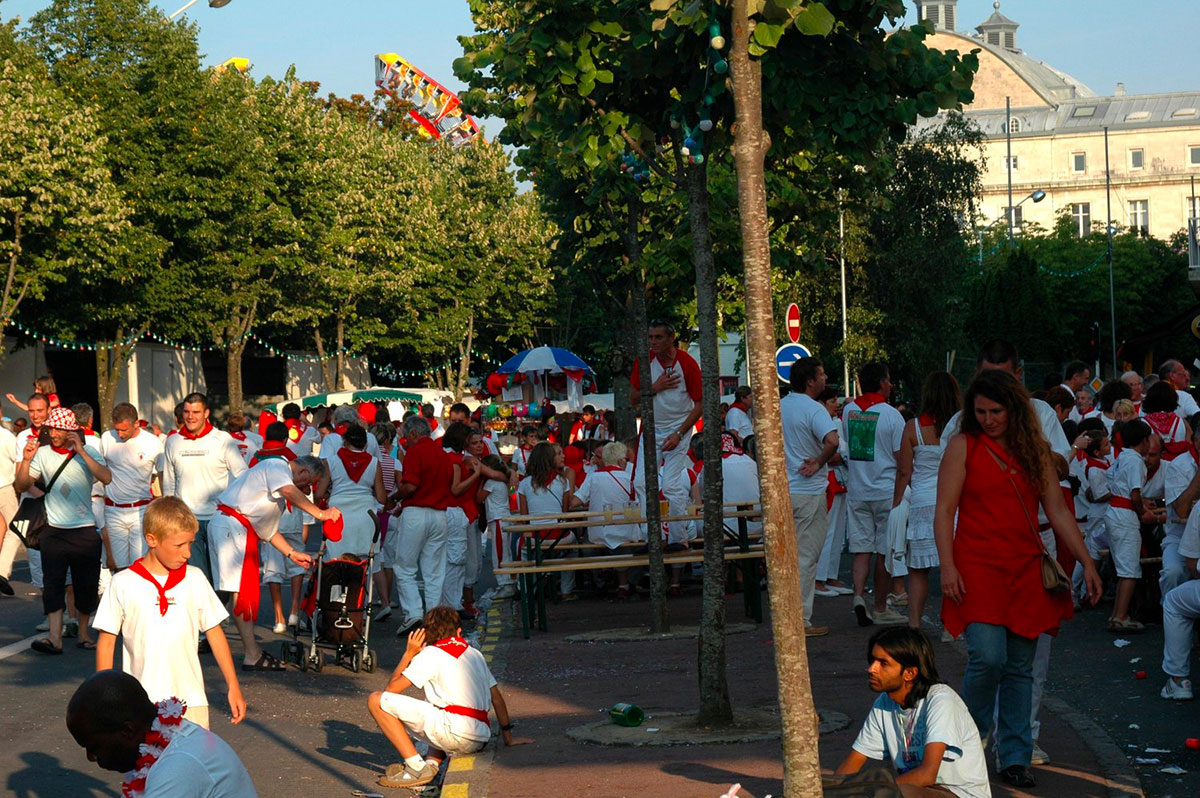
The dress code: white and red, no exceptions
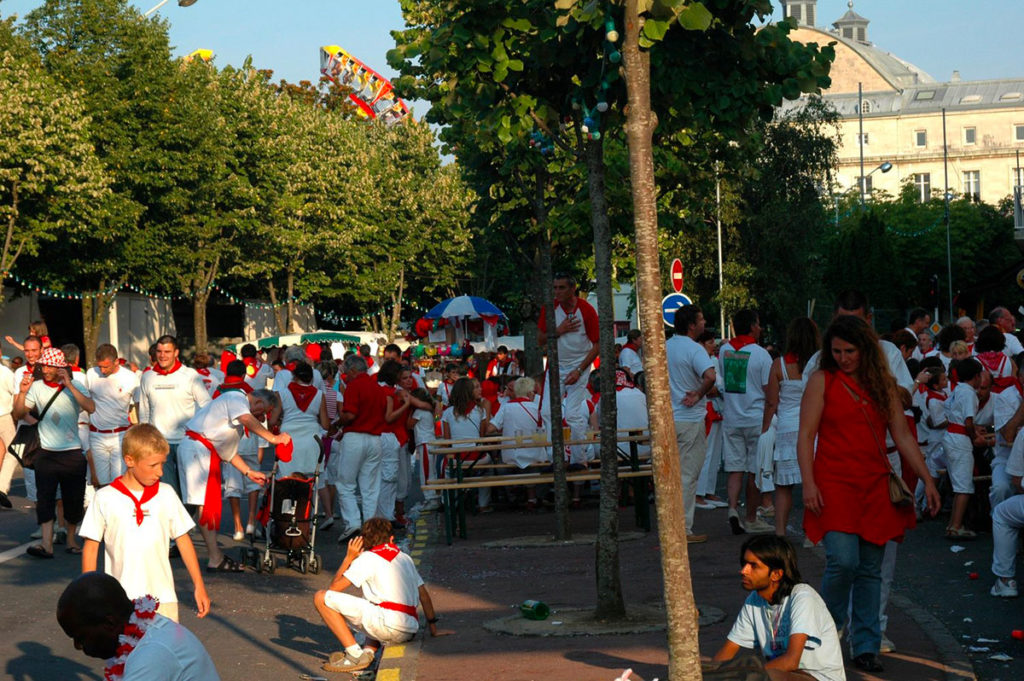
There’s no getting round it, and so much the better: white clothes, red neckerchief at the throat, red sash at the waist. The code isn’t folkloric red tape — it’s the password. It erases differences, melts the crowd into a single tide and turns any newcomer into a festayre. You’ll find the full kit all over town — right down to the official white-and-red beret — but regulars know: better to have it ready before you set off.
White and red aren’t a costume: they’re a way of belonging, for five nights, to something bigger than yourself.
The official 2026 poster: chosen by the festayres’ vote
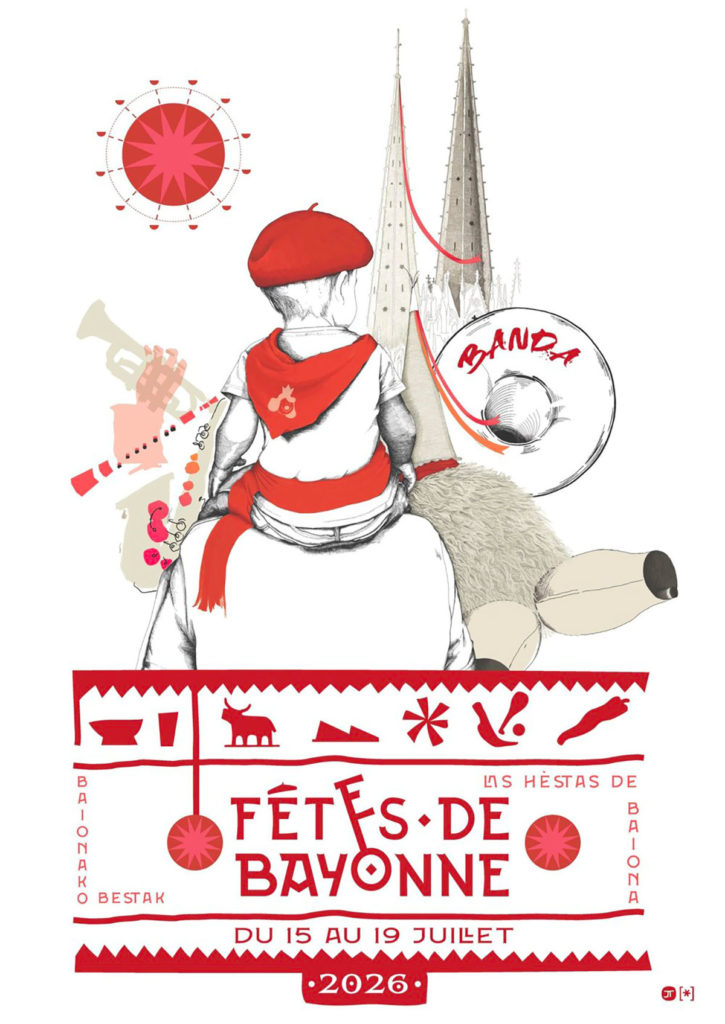
Each year the festival poster is chosen by competition: five finalists shortlisted by the City and the extra-municipal council, then decided by a public vote. For 2026, the winning design came from Janick Tanguy, an independent graphic designer based in Anglet.
A line illustration in the spirit of traditional drawing, it places family at the heart of the festival — a father carrying his son on his shoulders, red neckerchief and beret — and unfolds a festayre’s typical day, from Roi Léon’s awakening to the bandas’ parades. In the background, the cathedral spires and the perspective of rue Port-Neuf anchor the image in Bayonne; along the bottom, a frieze styled like a Basque farmhouse lintel (the altaburu) sums up the festival in symbols.
The programme, day by day
Wed. 15 · Opening
- 5 pm · throwing of the three keys (preceded by the Prosei gascon)
- Foulée du Festayre, start on the Côte des Basques
- World chilli-omelette championship, place Paul-Bert
- La Nive en fête (pirogues, paddleboards)
Thu. 16 · Children
- Poterne site, 12 pm – 6 pm (~6,500 children)
- 1st edition of the Junior Bandas Festival
- Live music only: no PA before 7 pm
Fri. 17 · Traditions
- The Pass Fêtes becomes compulsory from 10 am
- Parades, bandas, pelota and Basque dancing
- Balls and concerts across the city
Sat. 18 · Associations
- Parade of Roi Léon’s court
- Mounted bullfight (corrida) at the arena
- Grand peñas night
Sun. 19 · Closing
- Bandas mass, masters finals in pelota & Basque strength
- 10 pm · Corso lumineux (illuminated parade)
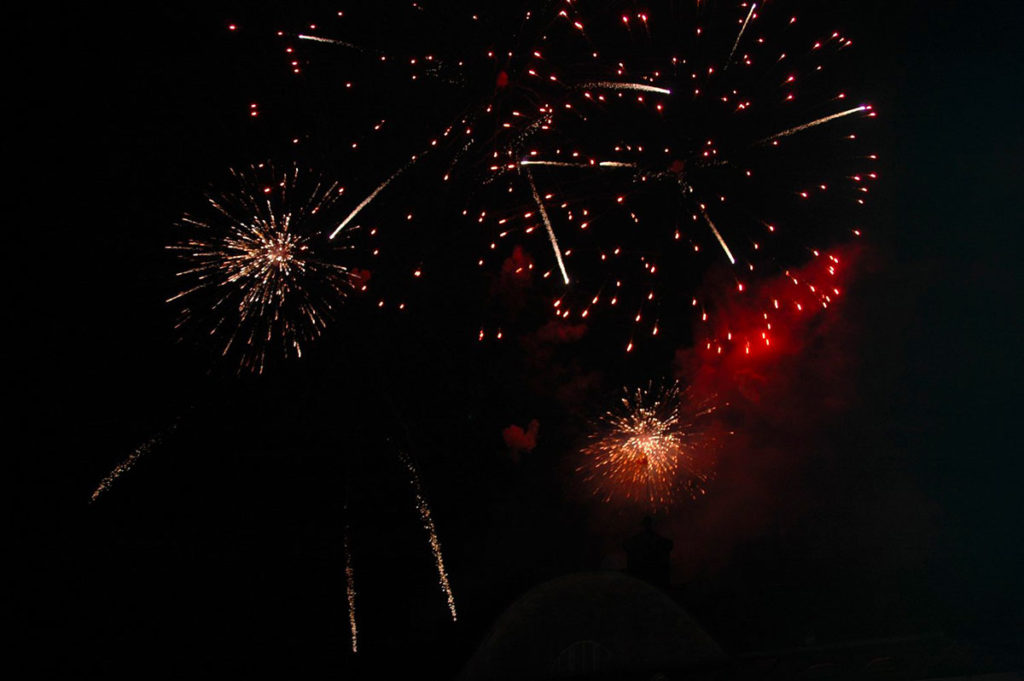
- Midnight · closing, place de la Liberté, then fireworks
Cow runs (vachettes) in the Petit Bayonne and corridas / novilladas at the arena (ticketed) punctuate all five days. Full programme: fetes.bayonne.fr.
From Biarritz: leave the car
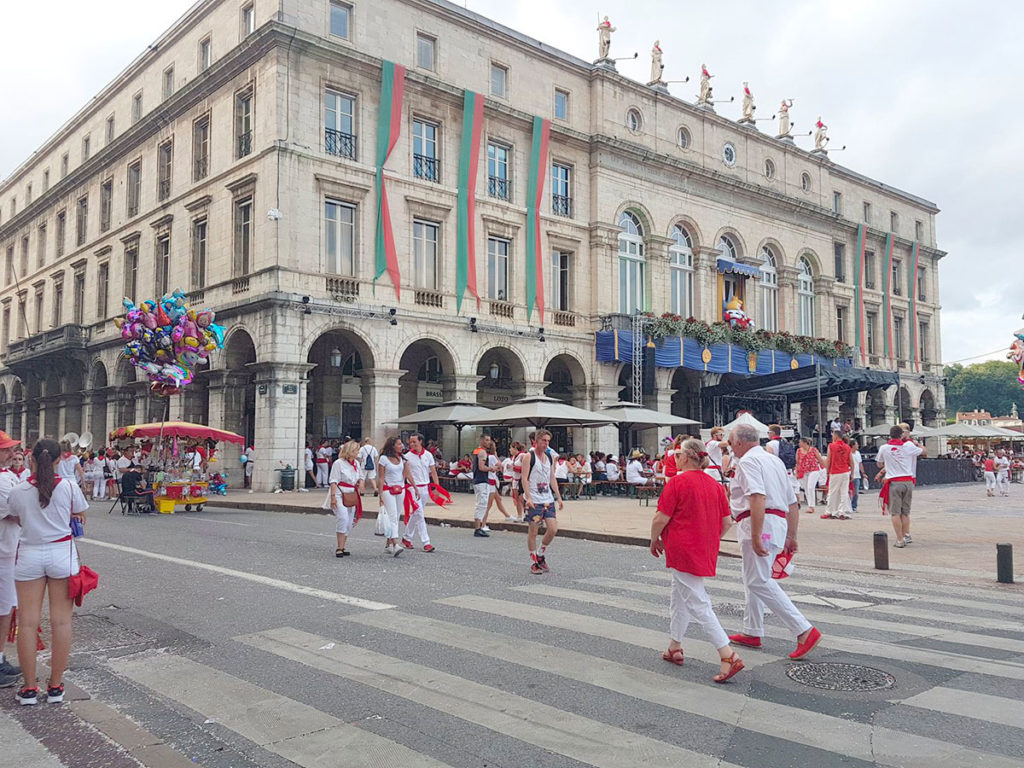
If you keep just one piece of advice, make it this one. Around the centre, traffic is sealed off by a security perimeter and parking is wishful thinking for the whole festival. From the Basque coast, two reflexes are enough: the train, unbeatable, and the festival bus network, designed to get everyone home right through the night.
The train, the simplest option
From Biarritz, Bayonne station is only a few minutes away. No traffic jams, no parking to hunt for. The TER Nouvelle-Aquitaine network steps up its services for the event, with a special daytime festayres offer. Buy tickets in advance to skip the queue.
The Txik Txak bus
A night network takes over from 8.30 pm to 4 am (3 am on Sunday night), lines renamed A to N; the Place des Basques becomes a bus station. By day, the T1 tram-bus links Biarritz to Bayonne. Fares: €8 Bus des Fêtes ticket (1 day + 1 night), €20 5-day wristband — free for Txik Txak subscribers.
The Pass Fêtes, how it works
Access is free on Wednesday and Thursday. From Friday 10 am, entering the festival perimeter means wearing the famous « Pass Fêtes » wristband on your wrist, at a flat rate of €15 for the last three days, from age 16. It funds the security and emergency services of an event on an extraordinary scale.
The wristband is required from Friday 10 am to Saturday 3 am, from Saturday 10 am to Sunday 3 am, then on Sunday from 10 am to midnight. It stays free for Bayonne residents, under-16s and professionals working within the perimeter — though wearing the wristband remains compulsory for everyone. You can buy it online, at the ticket booths at the entrances, at tourist offices and from certain approved resellers.
What you’ll see, what you’ll live
The Fêtes aren’t just about the bandas — even if they number more than a thousand musicians. Along the streets: parades of giants and big heads, cow runs (vachettes) in the Petit Bayonne, corridas and novilladas at the arena (ticketed), pelota, Basque strength games, dancing, the Corso lumineux on Sunday evening and the food of the Comptoir paysan, on the esplanade Roland-Barthes.
The insiders’ secret comes down to one word: the peñas. Closed the rest of the year, these clubs open their doors during the Fêtes and are behind most of the entertainment. Dare to push the door open: the night will only be the better for it.
The festayre’s good habits
- Water: a bottle, and rehydrate between drinks.
- Comfortable shoes: the cobbles show no mercy.
- A meeting point: agreed in advance with your group.
- An eye on your own: looking out for each other makes the best nights.
- The instructions: volunteers and security are watching over you — follow them.
- Never drive after drinking: the bus runs until 4 am, make the most of it.
Worth knowing too: animals are strongly discouraged (crowds, noise, vachettes), and accommodation in the area books up several months ahead — there are 1,000 camping pitches at the Mousserolles site.
Nearly a century of red and white
The first Fêtes de Bayonne date back to 1932, dreamed up by a group of Bayonne locals taken with Pamplona’s Sanfermines. In under a century they’ve become France’s biggest festive gathering: more than a million participants, over five days, and an entry in France’s Inventory of Intangible Cultural Heritage. A tradition that’s passed on — and that has already booked its next date, for 2027, from 14 to 18 July.
Ici Biarritz’s tip
Regulars say it every year: the best Fêtes aren’t necessarily Saturday night’s. The opening Wednesday, with the throwing of the keys, or the family Thursday often have a more authentic feel, and let you enjoy the city before the weekend crowds.
Whether you’re from Biarritz, from Bayonne or simply passing through on the coast, the rule is unanimous: come in white, knot your red neckerchief… and leave the car at home. The festival, for its part, begins right there on the station platform.
To plan your visit
The editorial team — Ici Biarritz · icibiarritz.com