
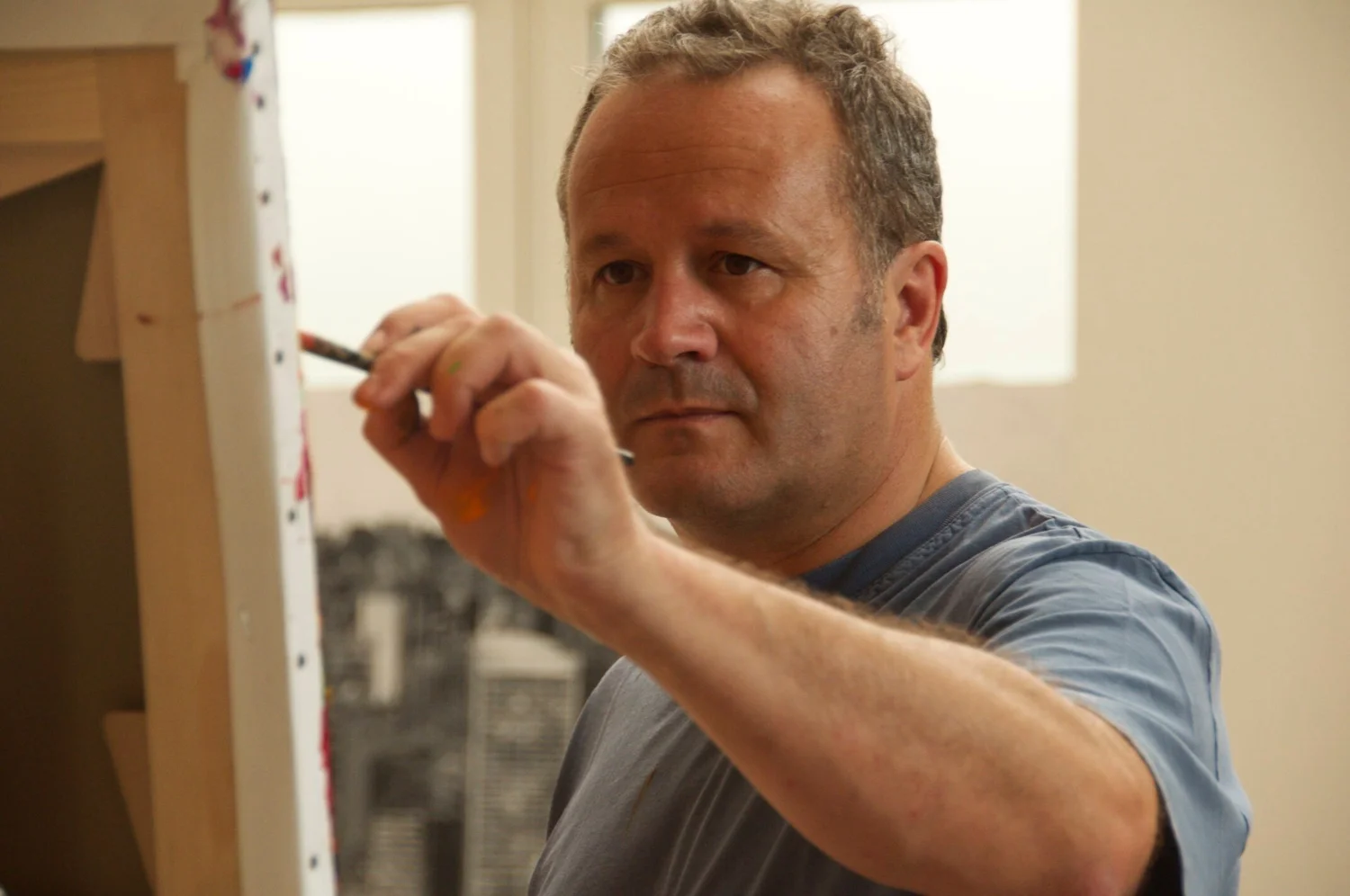
A star adored in Asia, exhibited from New York to Dubai, Jean-François Larrieu has nonetheless chosen the Basque Country as his home port. A conversation with a painter of joy who lives in Socoa, on the bay of Saint-Jean-de-Luz.
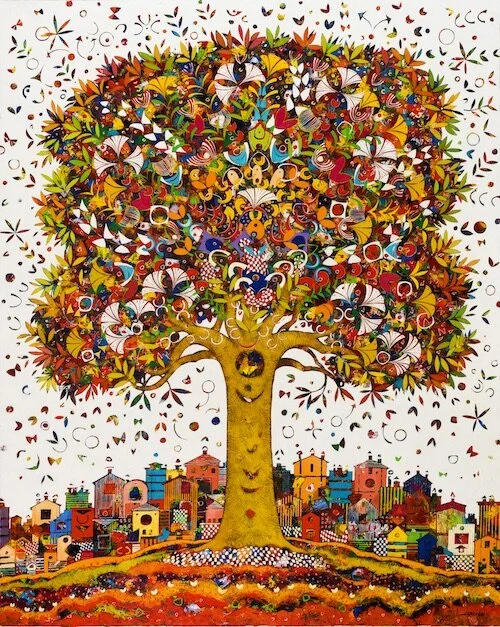
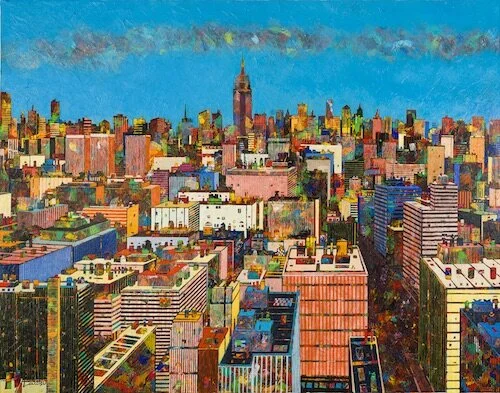
Standing before one of his works — a tree bursting with colour, a sky studded with tiny circles, a city that seems to breathe — you don’t feel like analysing: you feel like smiling. That is perhaps his greatest achievement. In a contemporary art scene that is often solemn, sometimes cerebral, Larrieu took the opposite bet: that of joy and wonder. A bet, held for more than forty years, that has taken him from the Pyrenees to the walls of New York, Hong Kong, Seoul, Dubai and Beijing.
The Pyrenees as a cradle
Jean-François Larrieu was born on 28 February 1960 in Tarbes, in the Hautes-Pyrénées. The South-West — its mountains, its light and its vegetation — would never truly leave him; they reappear, transfigured, in almost every one of his canvases. His vocation was precocious, almost disconcerting: at eleven he entered the François Villon painting academy. A year later, in 1972, when he was just twelve, he already received its painting prize. The child painted as others breathe.
Institutional recognition came very early. In 1978 he received the painting prize of the Musée Béarnais, in Pau, a city that devoted his first museum exhibition to him. At an age when many are still searching for their path, Larrieu already had a brush, a sure hand and an imagination. What he lacked was a territory to conquer. It would be Paris.
The conquest of Paris
In 1982, at twenty-two, he moved to the capital. But Larrieu is no recluse of the studio. Very soon a second vocation took shape alongside painting: the defence of artists. In 1987 he became a co-founder of the committee for the defence of artists at the Grand Palais. This taste for collective commitment would shape his whole life.
Responsibilities followed one another like a novel. A member of the board of the Salon d’Automne in 1990, he chaired it from 1995 to 2004. In 2003 he grandly celebrated the centenary of that legendary salon, bringing together for a historic photograph the descendants of the masters who made it — Bonnard, Cézanne, Derain, Picabia, Picasso, Renoir, Vuillard… A gesture of memory that says a great deal about the man: Larrieu sees himself within a lineage, heir to a history of French painting that he wishes to continue rather than reject.
In 2005 he was elected president of the Federation of Historic Salons of the Grand Palais. The following year he co-founded ‘Art en Capital’ (today Art Capital), a major event created to accompany the reopening of the Grand Palais. That same year, within the Salon Comparaisons, he founded the group ‘Écritures Exubérantes’, which brings together painters such as Robert Combas and Antonio Segui. Today he presides over the Fondation Taylor, the oldest artists’ mutual-aid society in France (see box) — a fine consecration for a man who has never stopped fighting for his peers.
What is the Fondation Taylor? Founded in 1844 at the initiative of Baron Isidore Taylor, it is the oldest artists’ mutual-aid association in France — painters, sculptors, engravers, architects. Recognised as a public-interest body as early as 1881, it supports creation by awarding prizes and grants each year, and by organising exhibitions in its Paris gallery on rue La Bruyère. Jean-François Larrieu is today its president. (taylor.fr)
When I paint, it is my whole body that creates… I let myself be guided by my instinct, like automatic writing.
An ‘unknown language’
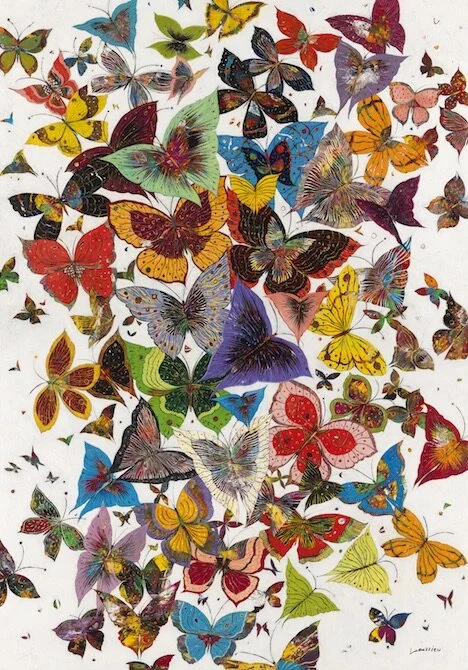
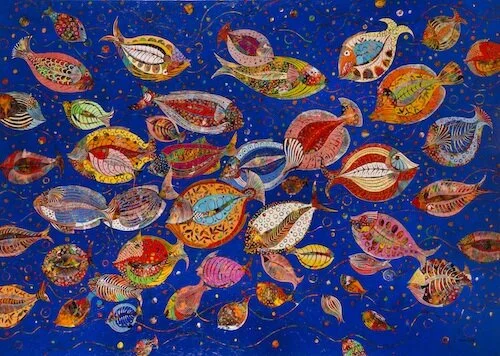
But the man of institutions must not overshadow the painter. Larrieu’s style rests on a simple and dizzying principle: accumulation. His canvases are covered with a multitude of small signs — triangles, circles, squares, dots, coloured commas — like a writing whose key has been lost, an ‘unknown language’ which, once assembled, forms a whole that is explicit and legible.
From afar, you read a majestic tree, a city, a face. Up close, the image dissolves into a myriad of vibrant, almost abstract touches. That is the whole game of Larrieu: he makes the eye drift ‘from the abstraction of the infinitely small to the figuration of the infinitely large’. You step closer, you step back, and the canvas changes nature before your eyes. He does not hide his mentors: he has often been compared to Paul Klee and Joan Miró. His favourite subjects speak volumes: flora first — the tree as an affirmation of roots — but also fauna and the ocean, a whole marine universe that he now extends even into immersive digital creations.
A star in Asia
For while Larrieu’s name is esteemed in France, it is in Asia that he has become a genuine star. In China first, where Shanghai welcomed him as a great figure: his canvases have been shown at the Liu Hai Su Art Museum and at the city’s Museum of Contemporary Art, and in 2008 he was among the artists of the official exhibition of the Beijing Olympic Games. He even created a stamp issued in China for the Year of France in China — a rare popular consecration for a Western painter.
In Taiwan, his standing is no less: the National Museum of Fine Arts, the Kaohsiung Museum of Fine Arts and the Taipei Museum of Modern Art have opened their walls to him. And in Seoul, the prestigious Opera Gallery — which represented him for years — devoted highly popular solo exhibitions to him, in 2008 and again in 2012. From New York to Hong Kong, from Dubai to Singapore and Tokyo, Larrieu has travelled the world; but it is indeed the Asian public that raised him to the rank of star. His name appears in the great art references — Bénézit, the International Art directory, the Who’s Who.
The Basque Country, home port
And yet, this global star has chosen to settle down… right here, among us. Far from the galleries of Seoul or Shanghai, Jean-François Larrieu today lives in Socoa, that little harbour tucked at the far end of the bay of Saint-Jean-de-Luz, a stone’s throw from Biarritz. Facing the sea wall and the ocean, between the Basque mountains and the Atlantic, he has found the setting that most resembles his painting: a clear light, a generous nature, an exuberance tempered by elegance.
The Basque Country is not, for him, a mere holiday spot; it is a return to his roots. The child of the Pyrenees rediscovers there the southern light that has always fed his work, that ocean he paints tirelessly, and that sweetness of life that surfaces in his canvases. For Biarritz and its bay, where art and the art of living merge, Larrieu is far more than a prestigious neighbour: he is one of us. Don’t be surprised, moreover, to run into him one morning under the covered market of Biarritz, basket in hand, or seated one evening at El Callejon — proof, if any were needed, that the star of Seoul and Shanghai is first and foremost a child of this land.
Painting joy
If there is one thing to remember about Jean-François Larrieu, it would be the conviction that beauty and joy are not naiveties but necessities. His trees, his cities and his skies do not seek to disturb us; they seek to connect us — to the living, to colour, to that ‘joy of dreaming’ that has always accompanied his name. His canvases invite us to do what we do best before a work by Larrieu: step closer, step back, and take the time to smile.
To read, to give, to take home. After nearly fifty years of painting, Larrieu signs his autobiography, Le Livre de Vie(s) : more than 300 pages illustrated with nearly a hundred works, in which the artist tells ‘the story of his lives’. Available in a standard edition (€49) and in a limited edition numbered to 150 copies with a digigraph of the Tree of Life (€120). You will also find his signed digigraphs, posters and silk scarves — including a series in the colours of the Atlantic and the Basque Country — on his online shop: larrieu.fr/collection.